An Airbnb arbitrage script should present a disclosed business proposal: your rent offer, intended guest use, operating controls and supporting documents. Ask for written permission, then confirm that local rules, building restrictions and insurance allow the arrangement.
A persuasive conversation cannot rescue a prohibited use or a deal that cannot carry its rent. Your first job is to establish whether the property qualifies; your second is to make the landlord's decision easier.
The scripts below are a landlord pitch template you can adapt, not transcripts of my conversations or a promise of approval. Replace every bracketed item with a fact you can support, and leave out any operating capability you do not have.
I've spent 18+ years in real estate, focused on short-term rentals since 2016, trained more than 10,000 operators through CashFlowDiary, and recorded 704 published CashFlow Diary™ podcast episodes.
If the business model is new to you, start with the complete rental-arbitrage guide. This playbook focuses on permission, evidence and the conversation—not a forecast of your returns.
This script is for arbitrage, not co-hosting: with co-hosting you manage someone else's listing for a fee and never sign a lease; with arbitrage you sign the lease yourself and carry the rent obligation whether or not the calendar is full. The pitch below assumes the second structure.
Check the deal before you pitch
Give each requirement a status: confirmed, unresolved or prohibited. Confirmed requires evidence; silence from a landlord, broker or city office is unresolved.
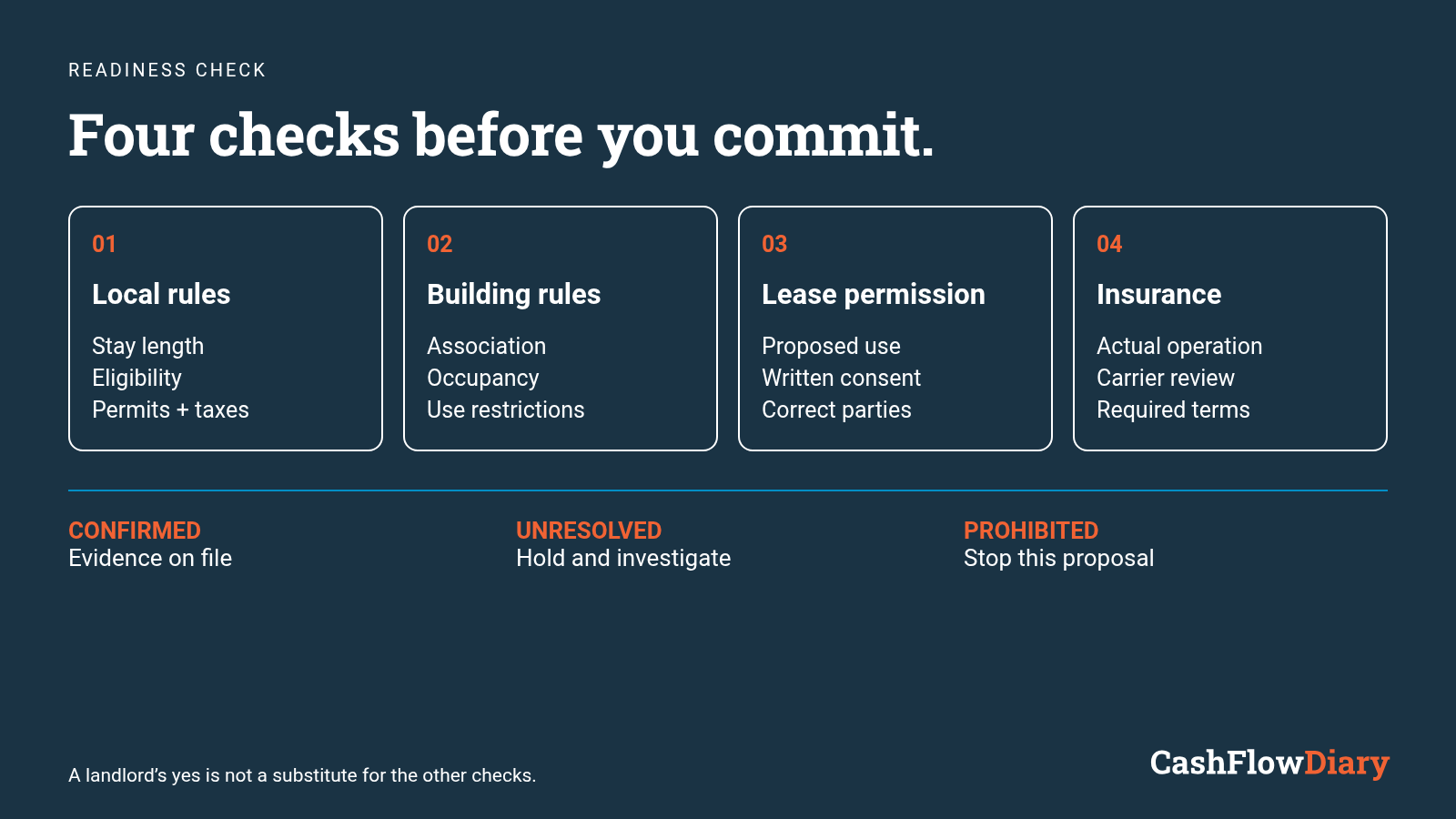
Review four separate layers before committing money:
Local rules: verify the intended stay length, operator eligibility, permits, registration, taxes and safety requirements for the address.
Building restrictions: read applicable association, condominium, cooperative and building rules. Identify who can authorize the use.
Lease permission: compare the proposed operation with the permitted-use, occupancy, assignment and subletting provisions.
Insurance: give the landlord's carrier and your licensed broker the actual proposed use, booking channels and stay lengths.
Airbnb's responsible-hosting guidance directs hosts to check leases, landlord permission, association restrictions and local requirements. A listing platform does not complete these checks for you.
Treat an unresolved item as a reason to gather evidence, not to sign and hope. A landlord's willingness to discuss the proposal does not establish that a permit will be granted.
Put each finding in a simple record: requirement, source, date checked, person responsible and next action. Keep the official rule or document—not just a screenshot of someone saying it is fine.
Recheck the economics separately. Use the underwriting walkthrough to test rent, operating costs and a weak booking month before deciding what you can offer.
Do not raise the rent offer merely to win approval. A premium belongs in the deal only if the operating model can support it.
Build a one-page landlord proposal
Make the first page readable without a sales presentation. Put the address, contracting entity, operator contact and proposed use at the top.
Then show the terms and evidence:
Rent and term: proposed monthly rent, payment date, lease length and any deposit, subject to applicable law.
Guest use: intended stay lengths, booking channels and occupancy limits, subject to permission and local rules.
Operations: cleaning between stays, lawful guest-screening practices, maintenance reporting and an emergency contact.
Insurance: broker contact, proposed coverage and the documents still awaiting confirmation.
Review conditions: unresolved permissions, approvals and professional reviews needed before signing or opening.
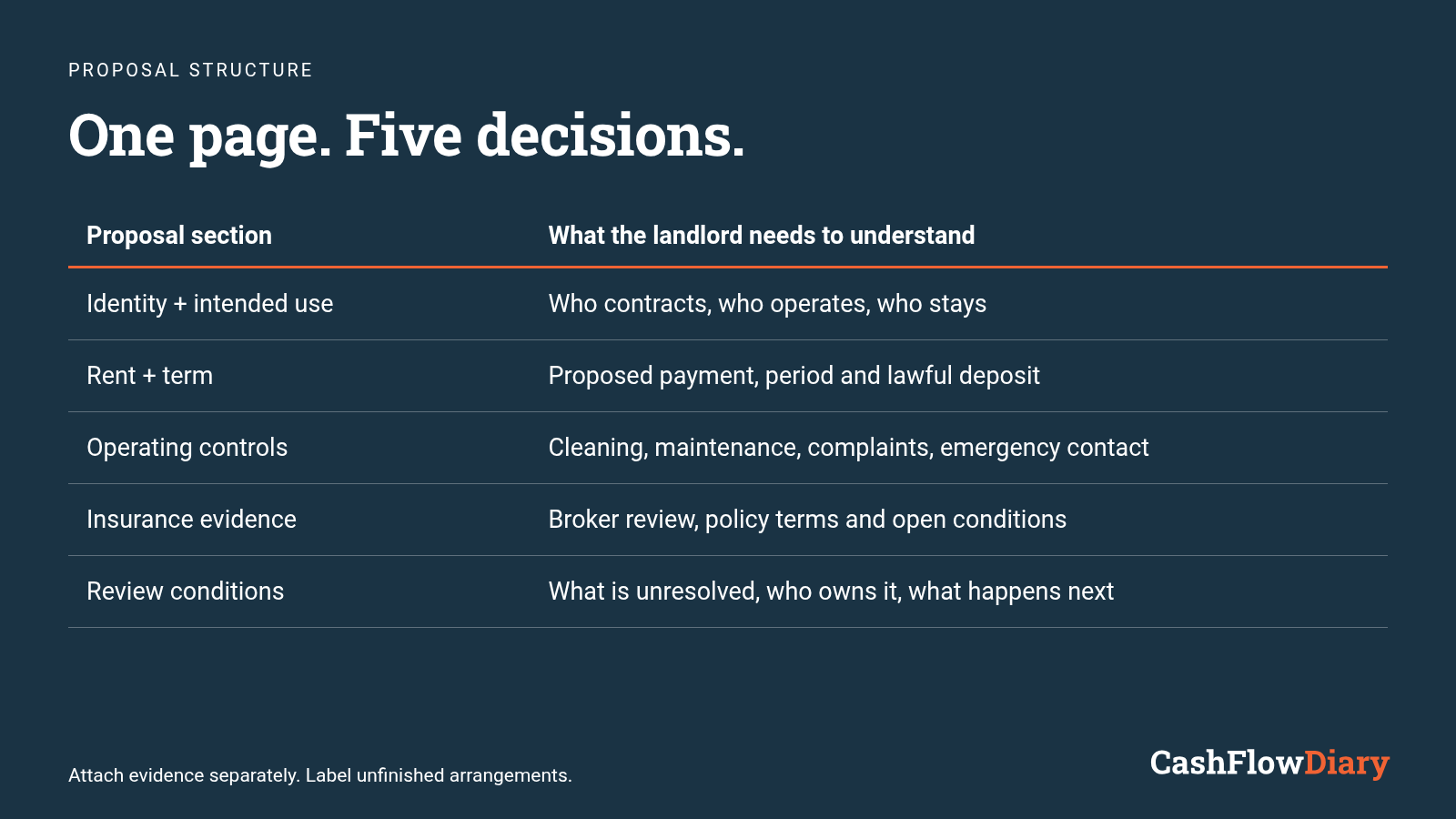
Use this proposal summary as a starting point:
Proposed operator: [entity and responsible person]. Intended use: [accurate description of guest stays and booking channels]. Proposed rent and term: [amount and period]. Outstanding conditions: [permissions, insurance and professional review].
Attach supporting evidence separately so the proposal stays short. A document list is useful even when something is missing, provided it says who will supply it and when.
If this would be your first unit, say so. Describe the systems you have prepared and the people available to deliver them; do not borrow another operator's results as your own.
Before sending, test every promise against a record or process. If you write “emergency response,” name the responder, backup and escalation method.
If you write “professional cleaning,” identify the provider and turnover checklist. An intention to hire someone later is not a working operating system.
Use a clear opening script
Your opening should tell the owner what you want to do before asking for a decision. Do not hide short-term stays behind vague language about corporate leasing.
“Thanks for speaking with me about [address]. I'm exploring a lease through [entity] to accommodate [accurately described guests] for [intended stay lengths], including bookings through [channels].”
“I want to be explicit about that use. Would you be open to reviewing a one-page proposal covering rent, operations, insurance and written permission? If the property or your plans do not allow it, I understand.”
If you already operate a business, you can say so. If you are preparing to launch, use “I'm preparing a proposal” rather than implying an established company with a portfolio.
When the landlord is interested, explain the boundaries:
“My proposed rent is [amount] for [term]. Those are contractual obligations I would need to fund even when bookings are weak. I'm not asking you to rely on a nightly-revenue projection.”
“Before either of us commits, I want the intended use reviewed against the lease, building rules, local requirements and insurance. Any permission needs to match the operation in writing.”
Keep the discussion about responsibilities, not your potential upside. The landlord needs to understand who pays, who responds, what is allowed and what happens when something goes wrong.
Avoid calling rent “guaranteed” as though nonpayment were impossible. A promise in a lease still depends on the tenant's capacity and the remedies available under the agreement.
Match the landlord's risk with evidence
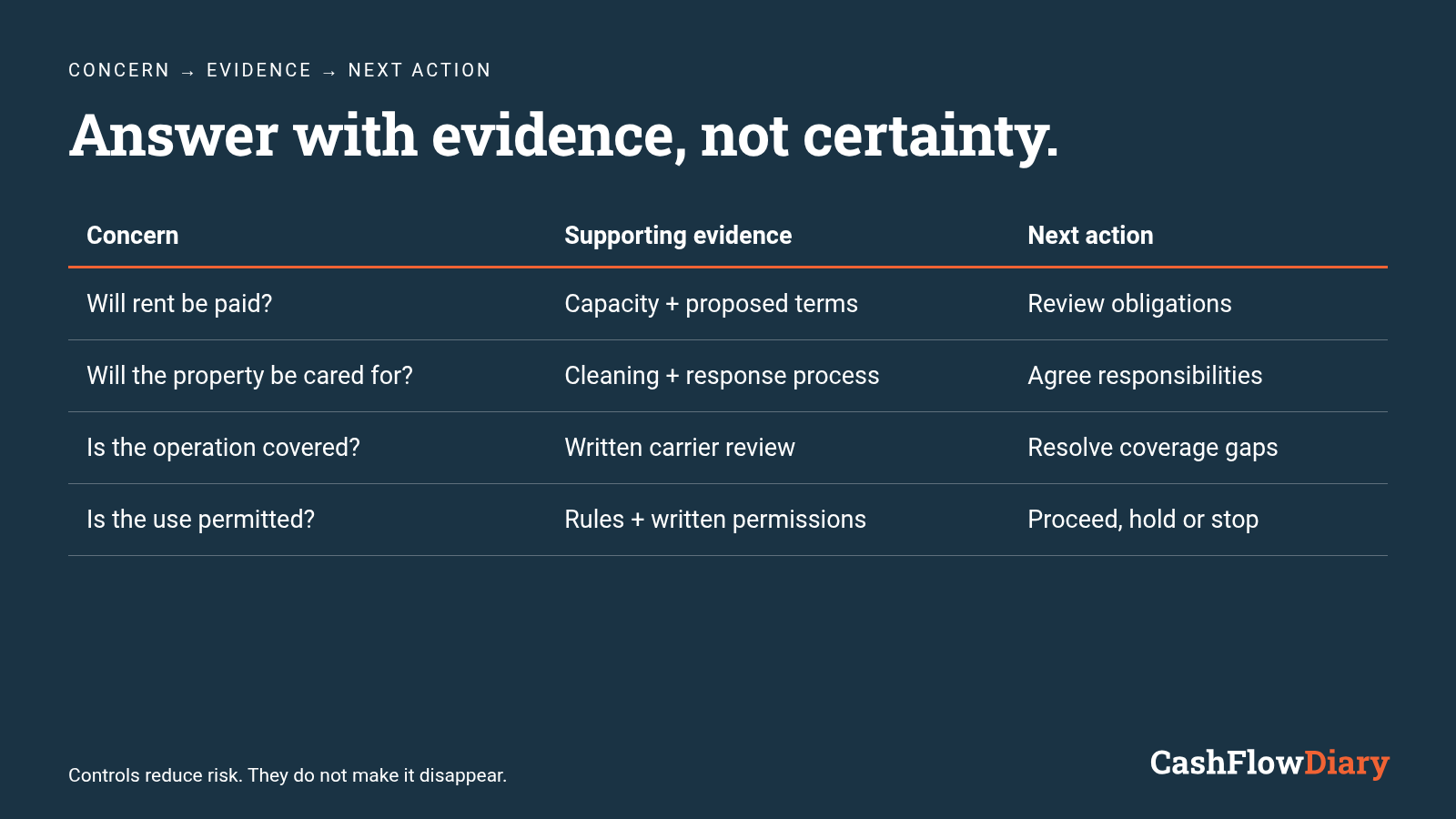
Prepare a concern-to-evidence checklist. A calm answer without a working process behind it is still a sales claim.
Payment concern → capacity and terms. Explain the proposed payer, payment method and lease obligations. Share appropriate evidence of financial capacity through a secure channel; do not expose unnecessary personal information.
Property-care concern → documented operations. Show a turnover checklist, maintenance log and escalation plan. Do not promise a fixed number of inspections unless your actual schedule supports it.
Neighbor concern → boundaries and response. Describe lawful occupancy controls, quiet-hour communication, complaint handling and the contact who can act. Controls reduce risk; they do not eliminate it.
Insurance concern → carrier confirmation. Supply the broker's response and relevant policy documents for the proposed use. Do not treat a certificate alone as proof that every activity or loss is covered.
For a first-unit proposal, an honest “not yet arranged” is better than a fictional operating history. It also gives you a concrete readiness list before you take on rent.
Answer four common landlord objections
These responses are conversation templates. They should lead to evidence or a decision—not pressure the owner into dismissing a concern.
“My insurance may not allow this.”
“Then we should pause until the carriers review the proposed use. I'll describe the stay lengths and booking channels accurately, and ask my broker what coverage and endorsements are needed.”
“You should also ask your carrier how the arrangement affects your policy. If the required protection is unavailable or uneconomic, this property is not a fit.”
Do not claim that every landlord policy excludes the use, or that one standard liability limit solves it. Coverage depends on the policy and circumstances.
Airbnb's Host Liability Insurance summary describes coverage subject to terms, conditions and exclusions. It does not insure the host's own property damage under that liability program.
Airbnb's Host Damage Protection terms, section 2.5, state that the protection is not insurance and does not replace insurance obtained or obtainable by the host.
Do not promise a universal order in which platform protection and commercial insurance will respond. Have the insurance professionals review the actual terms, including non-Airbnb bookings.
“What about parties, damage and neighbors?”
“Those are operating risks, not things I can promise away. Here are the occupancy rules, guest communications, cleaning process, complaint contact and maintenance escalation plan I propose.”
“Let's identify any additional building requirements before agreeing to the operation. If I cannot deliver the controls we agree on, I should not make the commitment.”
Use screening, monitoring and access practices only when lawful and consistent with platform rules and privacy requirements. Do not imply that a device or identity check prevents every incident.
Document how damage will be reported and handled. Keep that process separate from assumptions about whether a particular insurer or platform will reimburse a loss.
“The city or building does not permit short stays.”
“Then I won't pursue the short-stay model at this address. A different stay length would need a separate review of local rules, building restrictions, lease terms and insurance.”
“I would also need to understand the tenancy implications. I won't assume a monthly booking makes the same proposal acceptable.”
Airbnb's monthly-stay guidance warns that guests may establish tenant rights and that the applicable period varies by jurisdiction. Longer stays are a different operating decision, not a permission shortcut.
“Why wouldn't I do this myself?”
“You may prefer to, and that is a valid choice. My proposal is for you to receive the agreed rent while my business takes on the operating responsibilities specified in the lease.”
“The question is whether the terms and controls fit your priorities better than your alternatives. I can explain my proposed responsibilities so you can compare them.”
Do not exaggerate workload or belittle the owner's ability. Ask which alternative they are considering and what matters most: involvement, flexibility, risk or financial terms.
Review six lease topics with local counsel
Use this as an attorney briefing checklist, not ready-to-sign contract language. A rider may work in some situations; others need broader lease revisions.
1. Permitted use and written authority
Describe the intended stays, booking channels, operating entity and any occupancy restrictions. Ask counsel to identify which parties must consent and what happens if permission is withdrawn or rules change.
2. Guest occupancy and legal status
Ask how local law treats the proposed stays, agreements and occupancy arrangements. Calling someone a “licensee” does not justify promising that tenancy protections cannot apply.
Have counsel review guest agreements and lawful possession procedures. Do not build an operating plan around changing locks or removing an occupant without proper process.
3. Insurance and responsibility for losses
Coordinate the lease language with the broker and carriers. Address required coverage, evidence, renewals and any additional-insured status that is appropriate and available.
Have counsel review indemnity and liability provisions. A broad promise to cover every loss may create obligations your policy does not insure.
4. Maintenance, access and records
Define routine responsibilities, emergency handling, approval thresholds and notice or access requirements. Any dollar threshold should reflect the property and negotiated agreement, not an unsupported universal rule.
Explain who reports problems, who authorizes work and where records are kept. Include the process for damage that cannot wait for a routine review.
5. Compliance, registrations and taxes
Assign responsibility for researching, obtaining and maintaining required permissions, filings and tax arrangements. Confirm what a platform handles and what remains with the parties.
Specify what happens if an approval is denied, expires or becomes unavailable. Do not take bookings on the assumption that an application is equivalent to permission.
6. Term, default, renewal and exit
Discuss the lease term, renewal process, default provisions and termination rights. Address furniture, outstanding expenses and communications when the arrangement ends.
Resolve guest-booking wind-down with counsel and the relevant platforms. Do not promise that future reservations can always be honored after the right to occupy the property ends.
Close with a specific next action
The close should produce clarity: document review, further research or a respectful no. A referral is optional; it is not something the landlord owes you.
“Would you like to review the proposal and supporting documents? If so, who should receive them, what concerns should I address first, and when would a follow-up be useful?”
If the answer is no, ask whether the barrier is the property, the model or your proposal. Accept a firm refusal rather than treating every objection as something to overcome.
Record the outcome without inventing a target success rate. Track actual conversations, reasons for refusal and unresolved requirements so the next proposal improves.
Use this follow-up email after an interested conversation:
Subject: [Address] — proposed rental use and review items
“Thank you for discussing [address]. Attached is the proposal for [intended use], with [documents]. The open items are [list], and the next review is [agreed date or action].”
“Nothing in this summary assumes approval. Please flag any misunderstanding about the use or responsibilities before we proceed.”
Keep your own decision record just as clear. If insurance remains unresolved, write “hold for carrier response,” not “approved pending paperwork.”
Consider a hypothetical outcome: the owner likes the rent offer, but the building's rules have not been supplied. Your next step is to obtain and review those rules, not buy furniture.
FAQ: landlord permission for Airbnb arbitrage
Can I use Airbnb if my landlord says yes?
A landlord's agreement is only one part of the review. Confirm lease permission, building restrictions, local eligibility and requirements, and insurance for the proposed operation before committing.
Do I need a special lease?
You need an agreement that accurately addresses the intended use and responsibilities. Local counsel should decide whether an addendum or a revised lease is appropriate; a generic online template is not property-specific review.
Does AirCover replace my own insurance?
No. Airbnb's responsible-hosting guidance says its protections do not replace homeowner's, renter's or adequate liability coverage. Review the actual policies and program terms with your insurance professional.
Are stays of 30 days automatically allowed?
Do not assume so. Changing stay length requires a fresh review of applicable rules and agreements, and may introduce tenancy consequences. Airbnb itself warns that local and state tenancy rules can differ.
What if I have no operating history?
Say that you are preparing your first operation. Provide the actual business plan, responsible contacts and supporting evidence you have. Label unfinished arrangements clearly rather than presenting plans as proven performance.
Is Airbnb arbitrage still worth it?
It depends on the specific deal, not the business model in general. Arbitrage is worth pursuing only when the property clears the four checks above (local rules, building restrictions, lease permission, insurance) and the underwritten rent can carry itself through a weak booking month. Markets and platform terms change; recheck the numbers for your address rather than relying on a general answer.
Sources and your next step
Primary platform sources reviewed September 8, 2026:
These sources support the general cautions above. They do not determine whether a particular address is legal, insurable or financially viable; obtain the relevant official rules and professional advice for that property.
For related reading, review Airbnb gross revenue versus net profit before negotiating rent. Your offer should come from the economics, not enthusiasm for getting a yes.
Bring your proposal, address and unresolved requirements to a free STR Systems Diagnostic. Identify the next operating decision before committing to a lease.
For educational purposes only; not legal, tax, insurance or investment advice. Results are not typical. Past performance does not guarantee future results.