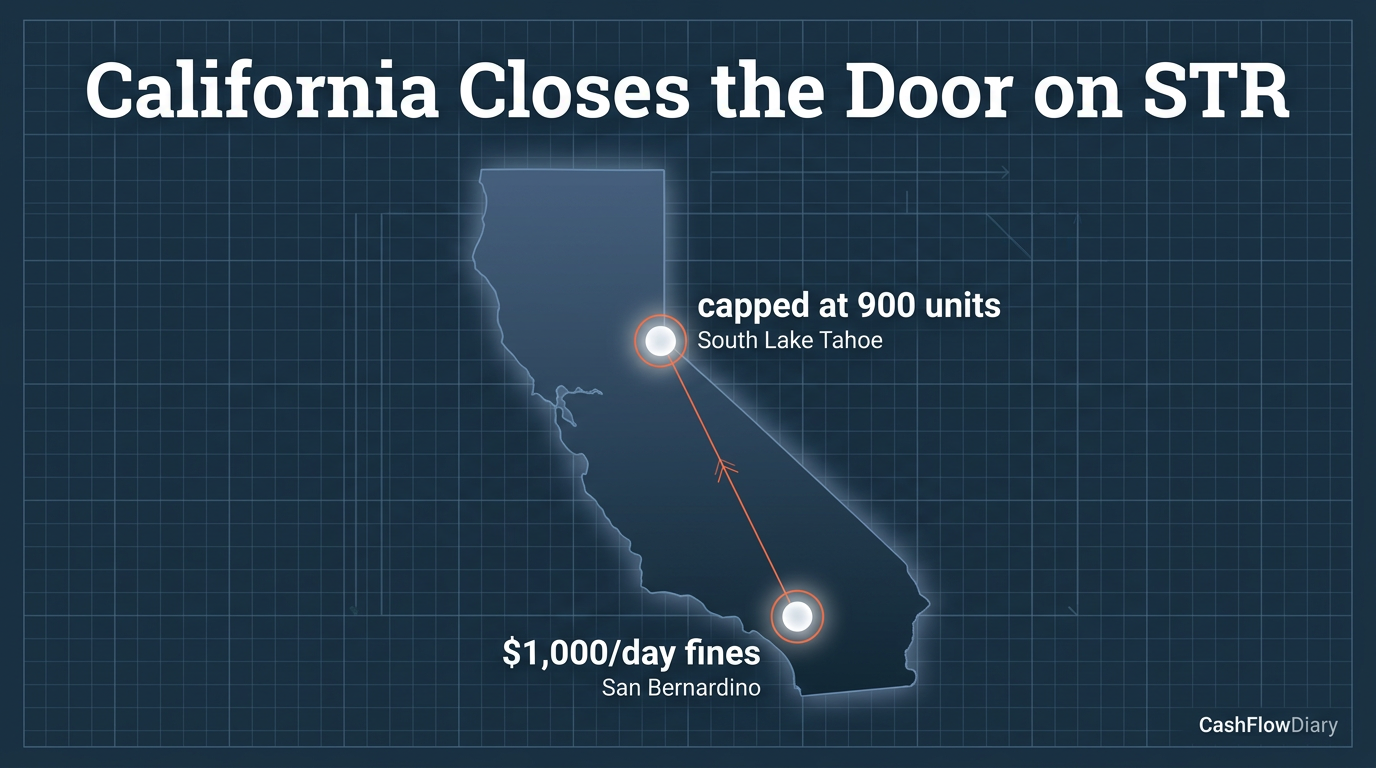
San Bernardino just made running an Airbnb a $1,000-per-day crime. South Lake Tahoe capped its short-term rental inventory at 900 units the same week. If you thought regulatory contagion was a New York and Barcelona problem, you weren't paying attention — but the answer most operators reach for is the wrong one.
The Problem Most Operators Don't See Coming

The standard reaction to a short-term rental ban is to evaluate whether you should leave the market. That's the wrong question.
Most aspiring operators treat their business model as the business itself. Short-term rental is what they think they sell. It isn't. What they actually sell is temporary lodging for someone who needs it. A city ordinance doesn't change that underlying need — only the use case.
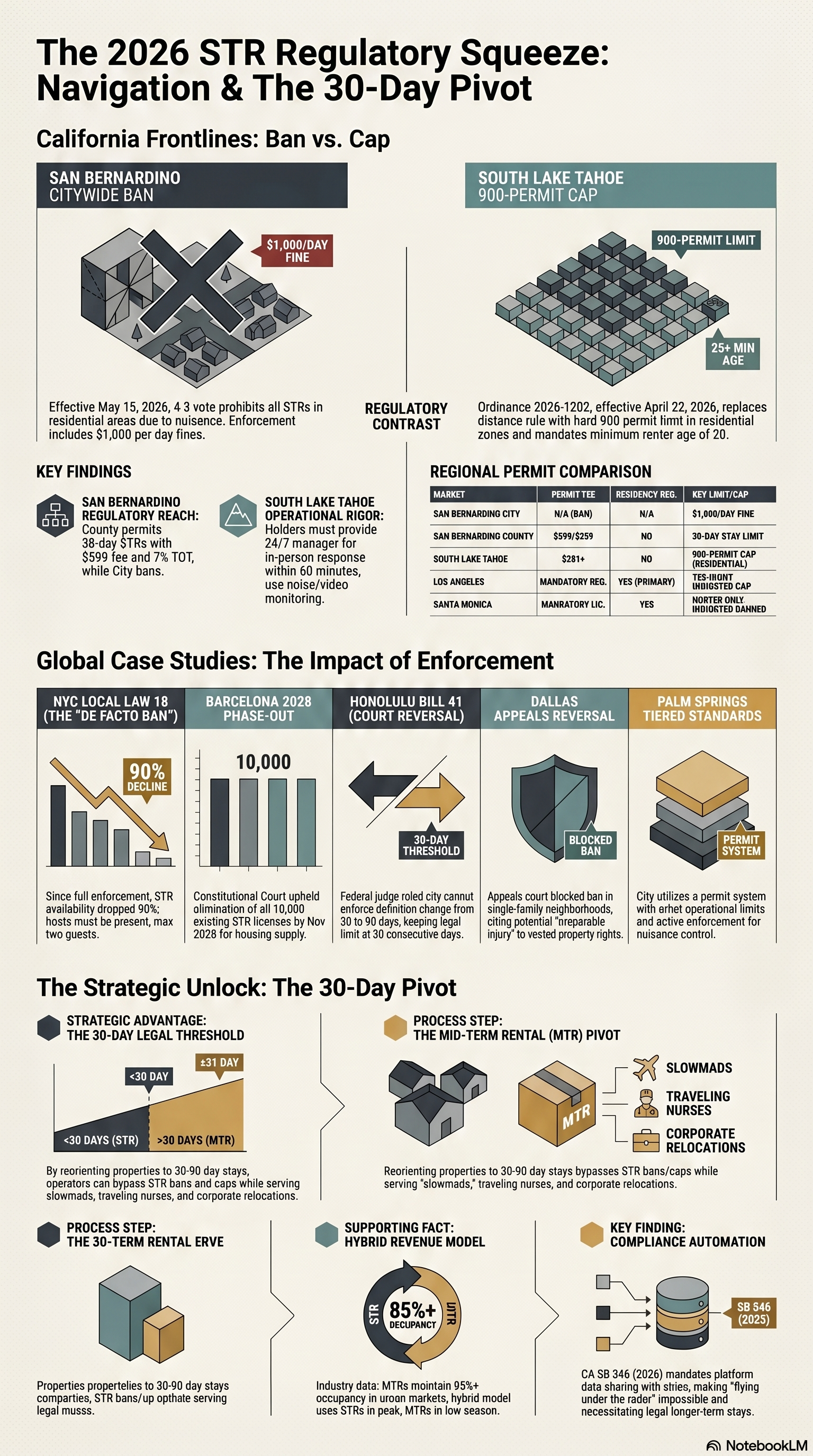
That distinction matters now because California turned its regulatory dial twice in the same week of May 2026. The City of San Bernardino voted 4-3 to ban short-term rentals citywide, with fines of $1,000 per day for operators who continue. The City of South Lake Tahoe adopted Ordinance 2026-1203, capping vacation home rental permits in residential areas at 900 total, with no buffer between units, a minimum renter age of 25, and no transferability when a property changes hands.
These weren't surprise actions. South Lake Tahoe had spent the previous twelve months working through court challenges to its Measure T. San Bernardino had been documenting complaints for years before the council vote. But they share a pattern with what's happening in New York City under Local Law 18, with Barcelona's 2028 phase-out, with Honolulu's Bill 41, and with Dallas — where the appeals court actually reversed the city's ban. The regulatory environment is now the most volatile variable in any STR investor's math.
It's also the most readable. Every ordinance is published. Every word in it is defined. And every definition has a boundary. The operators who read the boundaries can still serve the market. The operators who only read the headlines exit it.
Why California's 2026 Short-Term Rental Ban Isn't What Most Operators Think

At CashFlowDiary, we've coached short-term rental operators through every regulatory cycle since 2008 — through bans, caps, court reversals, and grandfathering battles. The pattern is consistent across every market and every decade: operators who survive the rule changes share one habit, and operators who exit share another.
We don't look at ordinances as caps. We look at them as telling you where, when, who, and how you can do the business.
Most aspiring operators think the regulatory question is binary: legal or illegal. It isn't. Every ordinance is a parameter set. San Bernardino's ban defines what a short-term rental is. It doesn't define what corporate housing is. It doesn't define what a 31-day lease is. It doesn't define what a furnished month-to-month rental is. Those are different categories of business operating in the same physical asset.
The reason this matters for cautious investors is concentration risk. If you buy a property as an Airbnb and the city bans Airbnbs, you've concentrated risk in a single business model. If you buy a property as temporary housing and structure your offerings to fit different regulatory definitions depending on which one your market allows, you've diversified at the operational level instead of the asset level. Same property, multiple business models. The ordinance can't take all of them.
"The ban changes WHERE you operate, WHEN you book, WHO you serve, and HOW you bill — not WHETHER STR works."
— J. Massey · CashFlowDiary
This isn't theoretical. Gallet Dreyer & Berkey LLP attorney Maximilian T. Ferlesch documented that Local Law 18 cut short-term rental listings in New York City by more than 90% within the first two years of enforcement. The operators who exited the market lost everything they had built. The operators who restructured into 30-day-plus furnished rentals — registered under different parts of the code — kept operating with adjusted economics. The asset didn't change. The use case did.
That's the model worth studying as you read the California ordinances.
What To Do: Read the Definition, Not the Headlines
Start with the actual legal text. Most operators talk about an ordinance in summary form before they've read a single word of it. Don't. The definitions section is where every short-term rental fight begins and ends.
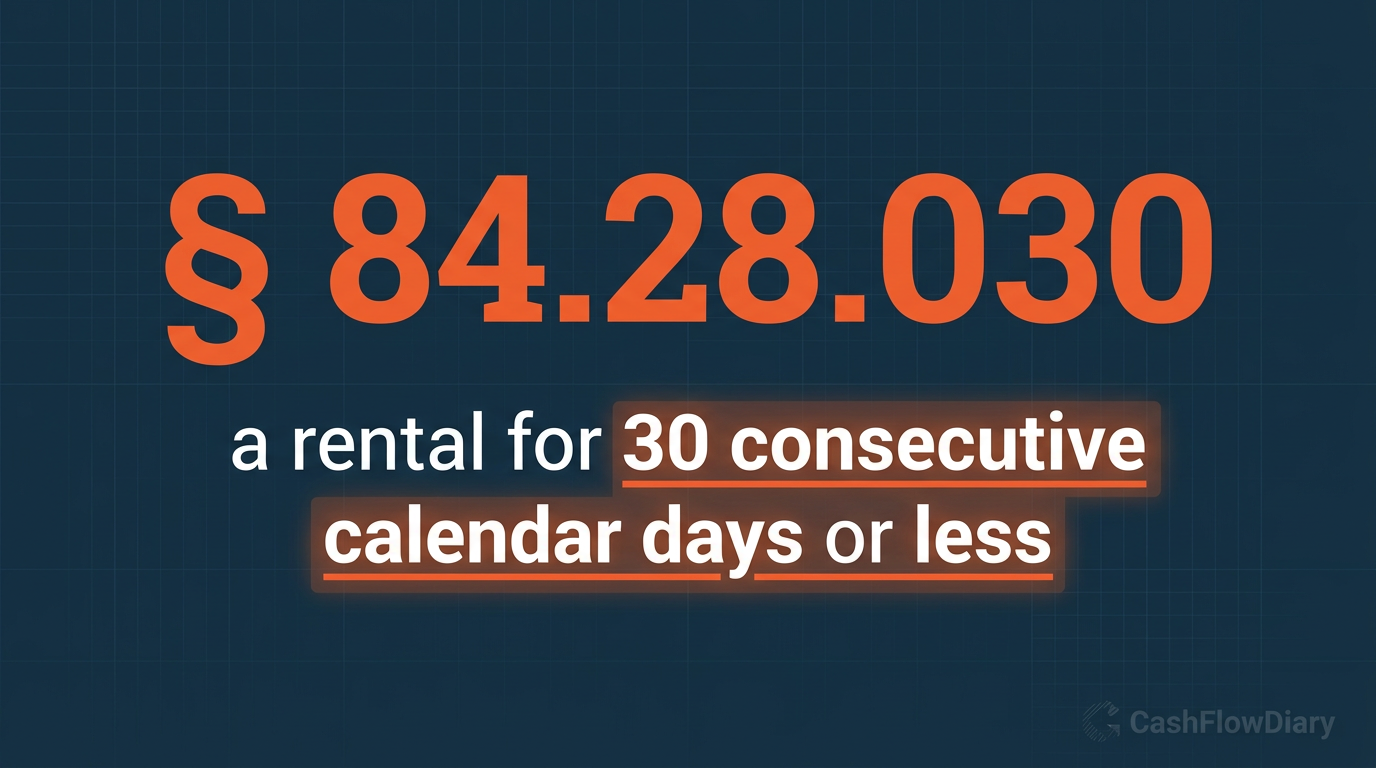
San Bernardino County's Short-Term Residential Rental ordinance, codified at Chapter 84.28, defines the regulated activity precisely:
“'Short-term' means 30 consecutive calendar days or less.”
“A short-term residential rental unit is a dwelling unit or portion thereof rented or otherwise used for residential transient occupancy.”
That's the legal trigger. Two conditions: length of stay below 31 days, and residential transient occupancy. If your business doesn't meet both conditions, the County's STR ordinance doesn't apply to you. Different ordinance, different rules, possibly fewer restrictions. The same arithmetic applies to the City of San Bernardino's new ban and to South Lake Tahoe's Vacation Home Rental ordinance — every California STR rule defines its regulated category by length of stay and occupancy type.
What this means for your strategy:
First, read the definitions section before you commit to a market. Not the press coverage. Not the operator forums. The actual code text. The County code library at amlegal.com, Municode, or the city clerk's office is where to start. If the definitions don't fit your business, the ordinance doesn't either.
Second, look for the structural boundaries the definition creates. A 30-day rule means 31-day stays are usually unregulated by the STR code. A residential-zone-only restriction means commercial-zoned units may be exempt. An owner-occupied carve-out means primary residences sometimes are. These boundaries are where alternative operating models live.
Third, if you operate in a market that has just capped or banned STRs and your license is grandfathered, your asset is partially insulated — but your strategy is still fragile. Part of your business may be safer. Your thinking is broken if you assume that safety extends to the entire business. Reinterpret the model before the next ordinance reaches you.
Hope that your market has ordinances. Markets without ordinances are not stable — they're the wild, wild west. Markets with ordinances tell you where, when, who, and how. That's the information you need to build something durable.
Frequently Asked Questions
Which California cities have banned short-term rentals in 2026?
As of May 2026, the City of San Bernardino has adopted an outright citywide ban (effective May 15, 2026, with $1,000-per-day fines). The City of South Lake Tahoe has implemented a cap of 900 permits in residential areas under Ordinance 2026-1203 (effective April 23, 2026). Other California municipalities are watching both ordinances closely as templates. The broader California Coastal Commission continues to push back against blanket prohibitions in coastal zones, which complicates the picture for any market touching the coast.
Is short-term rental legal in San Bernardino?
The unincorporated areas of San Bernardino County continue to allow permitted STRs under Chapter 84.28, which defines short-term as 30 consecutive calendar days or less. The City of San Bernardino, which is a separate jurisdiction within the County, has banned them outright as of May 15, 2026. Before operating in any San Bernardino address, verify which jurisdiction (City vs. County) the property sits in. Stays of 31 or more days fall outside the STR definition entirely and are typically regulated under different sections of the residential code.
What is the South Lake Tahoe STR cap?
The City of South Lake Tahoe adopted Ordinance 2026-1203 on March 24, 2026, capping Vacation Home Rental permits in residential areas at 900 total. The ordinance also requires a minimum renter age of 25, prohibits permit transfers when properties are sold (except into estate-planning family trusts), removes the previous required buffer between VHR properties, and requires permits in commercial and recreational areas to follow the Tourist Core Area Plan. The cap is residential-zone-only — commercial and recreational areas remain uncapped.
Can I still operate if my license was issued before the cap?
In South Lake Tahoe, yes — pre-existing VHR permits in good standing remain valid. But the permit is not transferable to a buyer if you sell the property (except into an estate-planning trust). That means your grandfathered status is personal, not asset-attached. In the City of San Bernardino, the ban applies citywide regardless of prior permit status. Verify the specific carve-outs of every ordinance you operate under before assuming any grandfathering protection.
Which California markets are still STR-friendly?
As of May 2026, California is moving steadily toward more regulation, not less. The short-term rental landscape varies dramatically by jurisdiction — coastal cities are constrained by the Coastal Commission's access-preservation mandate, large urban markets (Los Angeles, San Francisco) have multi-year-old registration requirements, and second-home markets (Palm Springs, Lake Tahoe, Mammoth) have moved toward caps. The question for cautious investors is no longer “where is California STR-friendly,” but rather “which jurisdiction's ordinance fits the business model I want to operate.” Read the definitions. Operate inside them. Stay diversified across length-of-stay categories.
Get Regulatory Analysis Like This As It Happens
Subscribe to the CashFlowDiary newsletter for weekly investor-grade coverage of the rules that shape your portfolio.