What Airbnb's Algorithm Actually Rewards
Most guides throw tips at you without explaining the mechanism. You need to understand how the system works before you work with it.
Airbnb's Help Center documents four ranking factors:
1. Quality — review scores, photo standards, listing completeness, response rate
2. Popularity — bookings, wish-list saves, click-through rates
3. Price — competitiveness relative to comparable listings in your market
4. Location — proximity to where the guest wants to be, plus filter-matching (whether your listing matches the guest's search criteria and filters)
The algorithm recalculates continuously. Your ranking shifts daily based on guest behavior and what signals you're sending.
Good news: you move the needle faster than you think.
Bad news: you lose ground fast if you stop maintaining the signals.
Airbnb states the algorithm "evolves over time." The platform processes over 800 signals per search query. Two guests searching identical dates and locations see different listings.
Here's what matters: the algorithm is proprietary and personalized to each guest. No host or third party controls ranking.
What you control is the signals you send, and whether they're the right ones.
Key point: Airbnb ranks on quality, popularity, price, and location, then matches listings to each guest's specific search and filters. Your job is to send the right signals and match what your target guest searches for.
How to Write Your Listing in Guest Vocabulary
Most hosts describe what they're proud of. Guests search for what they need.
Different vocabularies.
The fix: write from the guest's search query, not your own perspective.
Here's the mechanism:
When a guest filters for "pet-friendly," Airbnb shows only listings with that amenity checked. If you don't tag it, you're invisible to that search — even if you allow pets.
Same for "workspace," "hot tub," "EV charger," "self check-in."
Every filter is a gate. Every untagged amenity is a booking you won't see.
Your description and title factor into relevance matching. If a guest searches "remote work Nashville" and your listing says nothing about workspace or Nashville's business district, you're a weaker match.
How to do it:
Step 1: Write down the 3 guest types most likely to book your unit (business traveler, family, couple, remote worker, event attendee).
Step 2: For each type, write 3-5 phrases they'd type into Airbnb search. Not what you'd call your place — what they'd search for.
Step 3: Cross-reference those phrases against your current title, description, and amenity list. Every gap is a relevance miss.
This is about relevance and filter-matching — the documented mechanism in article 39. Not a keyword trick.
Matching your listing to how guests search. That's the system.
Key point: Every untagged amenity and every description mismatch makes you invisible to a segment of your target market. Write in the words guests search, tag every amenity you have.
How to Optimize Title and Description for Guest Intent
Your title and description are relevance signals. Write them for the guest who's searching, not for yourself.
Title guidelines (from Airbnb Resource Center):
Keep it short and mostly lowercase
Lead with a standout feature (specific amenity, location differentiator, use case)
Don't repeat what Airbnb already shows automatically (city, bed count, "new listing," "entire home")
Skip symbols, emojis, ALL CAPS, excessive punctuation
Aim for 50-60 characters
Weak title: "Cozy 2BR Apartment in Nashville"
Strong title: "Fiber WiFi | Walkable to Broadway | Quiet King Suite"
What changed: specific amenity (fiber WiFi), specific location context (walkable to Broadway), specific use case (quiet = good for remote workers or light sleepers). Three concrete reasons to click.
Description guidelines (from Airbnb Resource Center):
Structure it in clear sections: The Space, Guest Access, Neighborhood, Other Things to Note.
Answer the top 5 questions guests ask before booking — this reduces message volume and improves response metrics
Be realistic. Don't oversell. Guests who get what was promised leave 5-star reviews. Guests who got oversold leave problems.
Include terms your target guest searches: specific WiFi speed ("500 Mbps fiber"), specific workspace setup ("dedicated desk with monitor"), specific proximity ("4-minute walk to convention center")
Update quarterly — content freshness is a signal
The description isn't your brochure. It's the answer to every question a guest would ask before booking.
Key point: Your title drives clicks. Your description converts clicks to bookings. Write both in guest vocabulary with specific features, not vague adjectives.
What Photos and Amenities Do for Your Ranking
Photos
Your hero image is the most important single element. It determines click-through from search results.
Make it your highest-impact shot: the view, the living space, the pool, the feature that makes your unit different.
Strong listings: 15-30 high-quality photos.
Cover every space guests will use: bedroom, bathroom, kitchen, workspace, outdoor areas, exterior.
Natural light, tidy rooms, wide angles.
Professional photography improves click-through — it's a quality signal and a conversion tool. Hosts who used Airbnb Professional Photography saw a 21% increase in earnings and a 19% net uplift in bookings over the next 365 days.
Photos that over-promise create negative reviews, which damage ranking more than any click boost they generate. Accuracy matters.
Amenities
Every amenity you don't tag is a filter you're invisible behind.
List every real amenity. If you have it, tag it. If you don't have it, don't claim it.
High-impact amenities in most markets: fast WiFi (list the actual speed), dedicated workspace, self check-in, washer/dryer, parking, EV charger, pet-friendly, smart TV.
Safety amenities matter and should always be listed: smoke detector, carbon monoxide alarm, fire extinguisher, first-aid kit.
Strong listings tag 35+ amenities. If you're at 12, you're invisible in a large share of filtered searches.
Other ranking signals (from article 39):
Availability: Open calendar = more opportunities to match.
Price competitiveness: Priced too high vs comparables = deprioritized. Price isn't just revenue — it's a ranking input.
Response rate and speed: Falling below 95% response rate or exceeding 1-hour average response time hurts trust and ranking.
Instant Book: Listings that you book instantly may rank higher. The booking confirms automatically without you needing to accept each request.
Reviews: Recency matters. Recent 5-star reviews are an algorithmic trust signal. Review content matters more than star rating alone. Airbnb's system reads your reviews and factors specific mentions (cleanliness, communication, accuracy) into relevance scoring.
External search indexing: Enable the setting so external search engines (Google) index your listing page — worth turning on (article 3810).
Key point: Photos drive clicks. Amenities determine filter visibility. Response rate, Instant Book, and reviews build algorithmic trust. Each signal compounds the others.
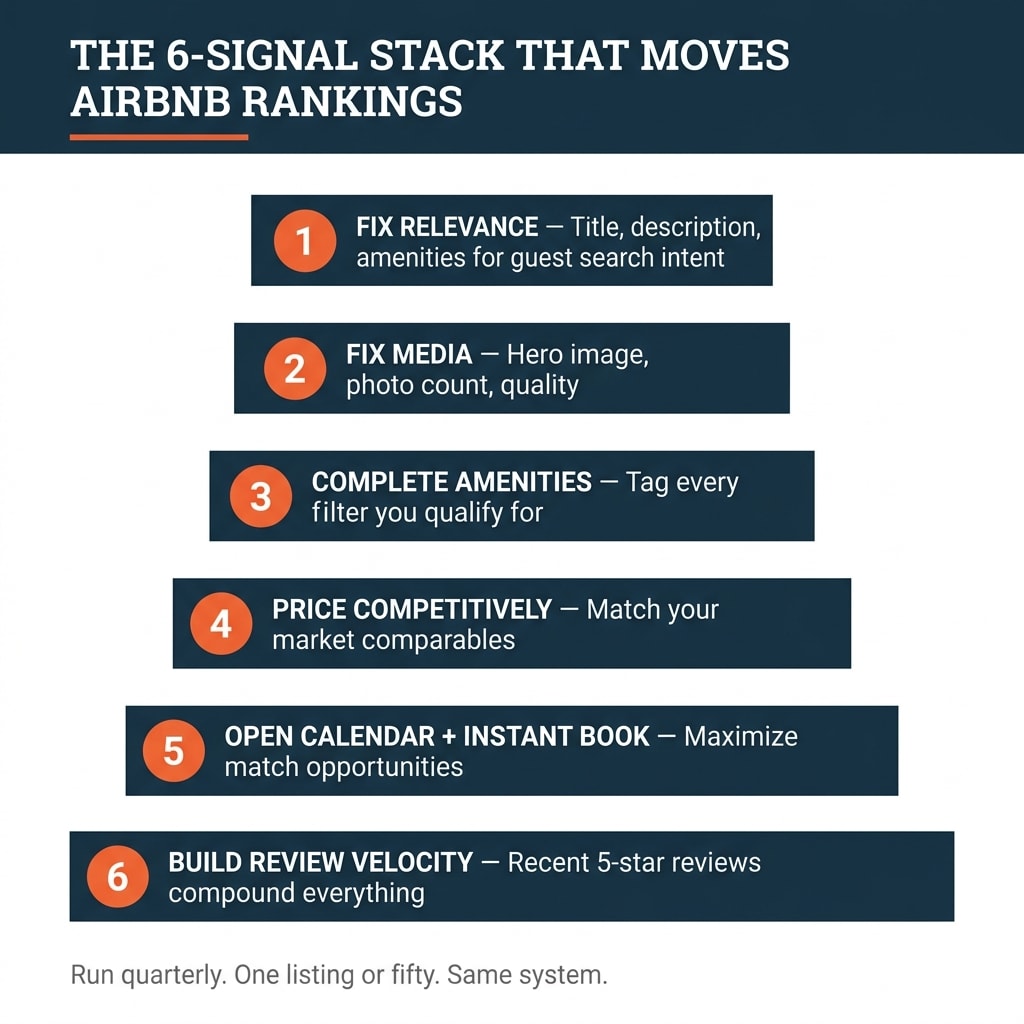
The Order of Operations: What to Fix First
Most guides give you 20 things to do without telling you what moves the needle first.
This is the run order based on the documented mechanism.
Step 1: Fix relevance first (title, description, amenities written for guest search intent)
Why first: Relevance is the gate. If your listing doesn't match what the guest searched, no amount of great photos or pricing will put you in front of them. Run the guest-vocabulary exercise from the section above before touching anything else.
Step 2: Fix your media (hero image, photo count, photo quality)
Why second: After relevance gets you into the results, your hero image determines whether the guest clicks. A weak first photo kills click-through before your price or description factors in.
Step 3: Complete your amenities and filters
Why third: Every unchecked amenity is a filter gate you're invisible behind. This is a 30-minute audit with immediate, compounding impact. Go through every amenity Airbnb offers and tag everything you have.
Step 4: Price competitively vs your market
Why fourth: Overpriced relative to comparables = deprioritized. Pull 10-15 comparable listings in your market. Where do you land? If you're above median without a clear differentiator, adjust. Dynamic pricing tools help automate this ongoing.
Step 5: Open your calendar and enable Instant Book
Why fifth: Wide-open availability gives the algorithm more opportunities to match you. Instant Book removes the biggest source of booking friction. Enable it during high-demand periods at minimum.
Step 6: Build review velocity
Why sixth: Recent reviews are the trust signal that compounds everything else. The fastest path: set accurate expectations in your listing (so guests aren't surprised), send a mid-stay check-in message to catch issues before checkout, ask for a review within 24 hours of checkout.
Time horizon: some signals (Instant Book, calendar, price) shift ranking within 48-72 hours. Review-based authority builds over 2-3 months.
Key point: Fix relevance before photos, photos before amenities, amenities before price. Signals stack. The order matters.
How to Make It a Repeatable System (For One Listing or Fifty)
The run order above isn't a one-time project. It's a quarterly operating cadence.
Here's how to turn it into a system:
Build a listing audit checklist that mirrors the 6-step run order. Every field, every amenity, every photo. One sheet per property.
Quarterly cadence:
Month 1: Run the full audit. Fix relevance, media, amenities, price.
Month 2: Monitor conversion rate, response rate, review sentiment. Adjust price and availability.
Month 3: Update description for freshness (new seasonal details, updated proximity info). Re-check amenity tags.
Repeat.
Who runs it: once the checklist exists, a trained co-host or VA runs it. Your job is to set the standard and review the output — not execute every field change personally.
For operators running multiple units: apply the same checklist to every listing. The mechanism is identical whether you have 1 unit or 10.
What changes is the market context (different guest types, different filter priorities, different pricing comparables). The system stays the same.
If you're scaling from rental arbitrage to multiple properties, this guide on building a 7-figure STR operation walks through the framework. For tracking the numbers that matter as you scale, here's the STR financial model we use.
Key point: Build the checklist once, run it quarterly. Delegate execution, own the standard. The system scales, your time doesn't.
What You Can't Control (And What Backfires)
What you can't control:
Airbnb's algorithm is proprietary. It changes. No host or third party controls ranking.
The algorithm is personalized to each guest — the same listing ranks differently for different searchers based on their history, preferences, and behavior.
Your competitors' moves. If five new listings open in your market next month with better photos, your relative position shifts.
What backfires:
Keyword-stuffed titles: Airbnb's guidelines say skip symbols, ALL CAPS, and excessive punctuation. Titles that read like keyword lists turn off guests even if they click through.
Listing amenities you don't have: Guests filter based on what you claim. If you list "hot tub" and don't have one, you'll get a 1-star review and a potential suspension. The review damage compounds far longer than any ranking boost you got.
Gaming signals you can't sustain: If you turn on Instant Book for a ranking boost and then cancel bookings you don't want, Airbnb penalizes host-initiated cancellations hard. Only use signals you sustain.
Over-optimizing for the algorithm, under-optimizing for the guest: The algorithm's goal is to surface listings that produce 5-star stays. If your listing gets clicks but doesn't convert — or converts but generates bad reviews — the algorithm will correct for that. The best SEO for Airbnb is a listing that accurately represents a great property and a host who delivers on it.
⚠️ This is operator education, not a promise of search placement or income. Airbnb's ranking algorithm is proprietary, personalized to each guest, and changes over time — no host or third party controls it. Results vary by market, property, and execution.
Key point: The algorithm rewards listings that produce 5-star stays. Optimize for the guest experience, not the algorithm. The ranking follows.
FAQ: Common Questions About Airbnb Search Optimization
How does Airbnb decide which listings to show in search?
Airbnb's algorithm ranks listings on quality, popularity, price, and location, then matches them to each guest's specific search criteria and filters. The system recalculates continuously based on real-time guest behavior. Source: Airbnb Help Center, article 39.
How do I optimize my Airbnb listing for search?
Write your title, description, and amenities in the words and filters your target guest searches, add high-quality photos, price competitively, respond fast, and keep recent reviews coming. Run the 6-step signal-stack in order — relevance first, reviews last.
Do keywords in my Airbnb title help ranking?
Your title helps guests choose your listing. Amenities and characteristics drive filter visibility. Match real guest intent — use specific amenities and location context, and don't repeat information Airbnb already shows automatically. Keyword stuffing hurts.
How many photos and amenities should an Airbnb listing have?
Strong listings use a clear hero image plus 15-30 quality photos and list every real amenity, because amenities power Airbnb's search filters. Missing amenity tags make you invisible in filtered searches — even if you have the feature.
Does Instant Book improve Airbnb search ranking?
Listings you book instantly may rank higher because the booking confirms automatically without you needing to accept each request. Only enable it if you sustain it — host-initiated cancellations carry a ranking penalty. Source: Airbnb Help Center, article 39.
How long until a new Airbnb listing shows in search?
New listings usually appear in search within 24 hours, though it takes longer sometimes. Airbnb's system is built to help new listings get early visibility. Use the new-listing boost by launching with a complete profile, competitive price, and Instant Book enabled. Source: Airbnb Help Center, article 39.
Key Takeaways
Airbnb ranks on four factors: quality, popularity, price, location. Your listing gets shown when it matches what guests search and filter for.
Write title, description, and amenities in the exact words your target guest searches. Every untagged amenity makes you invisible in filtered searches.
Stack quality signals in order: fix relevance first (guest vocabulary), then photos (hero image + 15-30 quality shots), then amenities (tag everything you have), then price (competitive vs comparables), then Instant Book and calendar availability, then review velocity.
The system isn't a one-time fix. Run the 6-step audit quarterly. Build the checklist, delegate execution, own the standard.
The algorithm rewards listings that produce 5-star stays. Optimize for the guest experience, not the algorithm. The ranking follows.
About the author: J. Massey is an active STR operator and educator at CashFlow Diary. Last updated: 2026-06-23.
Want expert eyes on your specific listing and market? Book the AI + STR Diagnostic and we'll find the highest-leverage fixes for your situation.
Get the weekly operator playbook — real STR systems, no hype. Subscribe here.
New to rental arbitrage or thinking about your first property? Start with the complete Airbnb arbitrage guide.
Learn STR Operations the Right Way
Every operator I work with goes through this audit before we build the second channel, the second guest type, the second pricing model. If you want the full framework — the platforms, the compliance sequence, the pricing model that protects margins through regulatory shifts — that's what we map in the STR diagnostic.
Start your diagnostic →