On Reddit this week, a real estate investor laid out exactly what it takes to scale an STR portfolio through property ownership: commercial loans with 5-year balloon payments, 25% down, a lender who wants to see the building's DSCR instead of your personal income, CapEx reserves for roof replacements that run a "completely different budget conversation" than a small rental, and professional property management eating 8–10% off the top before you see a dollar.
He wasn't complaining. He was warning other investors that the jump from conventional to commercial financing is more complicated than most people expect.
This article is about the other path.
If you want to run a short-term rental in 2025 — on Airbnb, VRBO, or Furnished Finder — you do not need to own a property to do it. You do not need a mortgage. You do not need 25% down. You do not need to qualify for a commercial loan or absorb the risk of a 12-unit building's roof replacement.
What you need is a different model, a clear understanding of how it works, and the discipline to execute it correctly.
The Two Ways to Run a Short-Term Rental (And Why One Gets Overlooked)
There are two ways to operate a short-term rental. Most people only know about one of them.
Option 1: Own the property. You purchase real estate, list it on Airbnb or VRBO, and collect rental income that (hopefully) exceeds your mortgage, insurance, taxes, and maintenance costs. Upside: you build equity and appreciation over time. Downside: you need capital, credit, and the ability to absorb the full cost of the asset. Getting into your first property can require $40,000–$80,000 or more depending on the market.
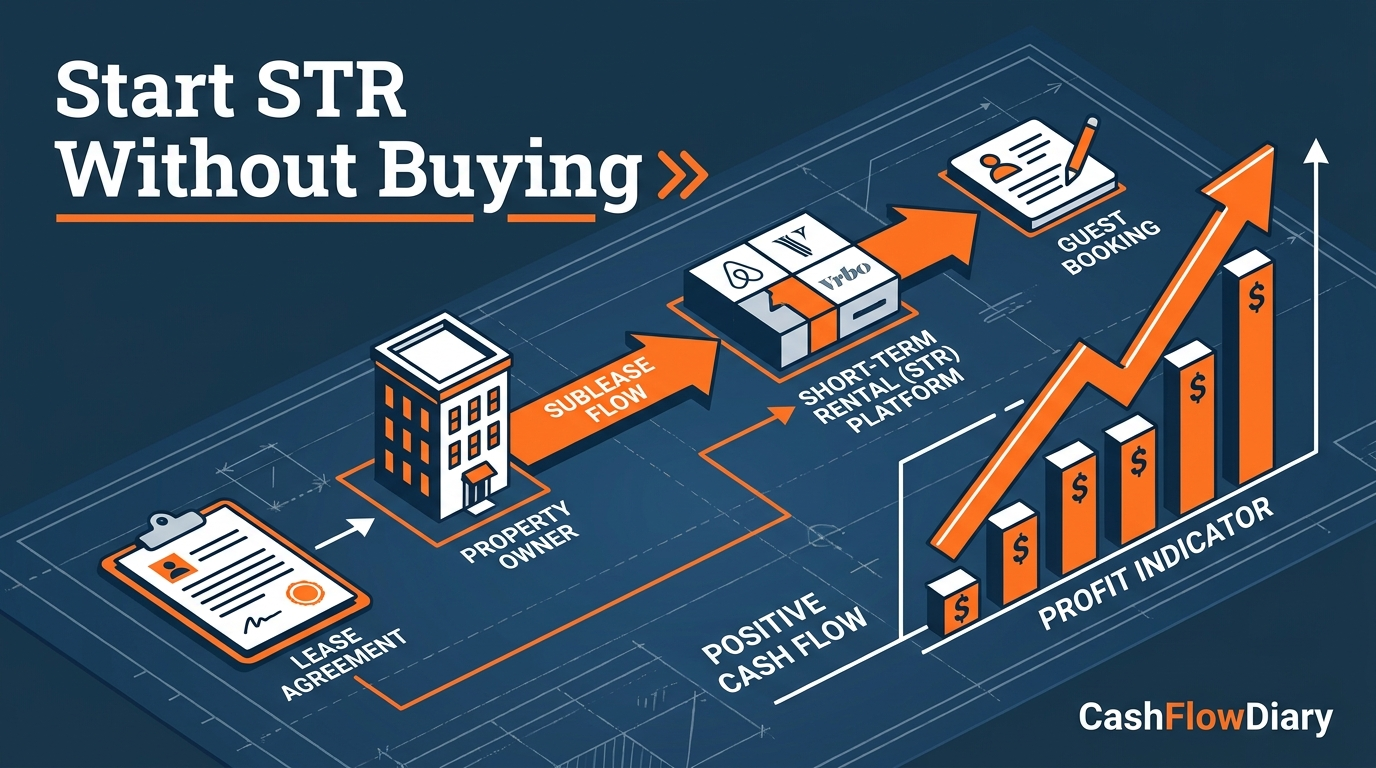
Option 2: Rental arbitrage. You lease a property from a landlord at market rate, furnish it, and sublease it as a short-term rental. The spread between what you pay monthly and what you earn from short-term guests is your profit. You do not own the property. You do not build equity. You do not need a down payment. Your startup cost is a fraction of what it costs to buy.
The reason rental arbitrage gets overlooked is simple: it sounds too straightforward to be real. If you could just lease a property and turn it into an Airbnb, wouldn't everyone do it?
Some people do. They keep quiet about it because they're busy running profitable STR businesses while everyone else is waiting to save up enough for a down payment.
What Rental Arbitrage Is — In Plain English
Rental arbitrage is a lease agreement with a specific permission built in: you are allowed to sublease the property for short-term stays.
You lease a unit — typically a 1-bedroom, 2-bedroom, or 3-bedroom apartment or house — for $1,200–$2,200/month depending on your market. You furnish it. You list it on Airbnb and VRBO. You charge guests $100–$250/night. When you run occupancy above 60%, the math starts to work.
A simple example:
Master lease: $1,500/month
Utilities + platform fees + supplies: $400/month
Total monthly cost: $1,900
Revenue at 70% occupancy, $130/night ADR: ~$2,730/month
Monthly net: ~$830
That is not a retirement fund from one unit. But it is a proof of concept — and it is a business model that scales. Two units at $830/month net is $1,660. Five units is $4,150. Ten units is where serious operators start.
The ceiling on rental arbitrage is not capital — it is execution. You can add a unit the same month your current unit is performing well. No bank approval required.
The Startup Cost Breakdown: What You Actually Need
This is where most people get it wrong. They assume starting an STR without owning property is "free" because there's no down payment. It is not free. It has startup costs — they are just dramatically lower and primarily recoverable.
Realistic startup cost for one arbitrage unit:
| Item | Cost Range |
|------|-----------|
| First month's rent | $1,200–$2,200 |
| Security deposit (typically 1–2 months) | $1,200–$4,400 |
| Furniture package (full unit) | $3,000–$8,000 |
| Supplies, linens, kitchenware | $400–$800 |
| Photography (professional listing photos) | $150–$300 |
| STR platform fees (setup is free; fees come from bookings) | $0 upfront |
| LLC formation (recommended) | $50–$300 |
| Total range | $6,000–$16,000 |
The median operator gets a first unit running for $8,000–$12,000. Compare this to $40,000–$80,000+ to purchase property in the same market.
The furniture and supplies are capital you own. If you exit the unit, you take the furniture. The security deposit is returned (assuming normal wear and tear). Your real sunk cost — the actual risk capital — is closer to your first two months of rent: approximately $2,400–$4,400.
That is a manageable first bet.
How to Find Properties Whose Owners Want This Arrangement
The most common question new arbitrage operators ask is: "Why would a landlord agree to this?"
The better question is: "Which landlords are already open to it — and how do I find them?"
Some landlords actively prefer arbitrage tenants. Here is why:
Arbitrage operators furnish units at their own expense, which means the landlord gets the unit back furnished at the end of the lease — or can roll it into a higher-rent furnished listing.
Operators who are running a business are motivated to maintain the property. A trashed unit costs them money too.
Arbitrage operators often pay above-market rates because the economics support it. You may offer $1,700/month for a unit that rents for $1,500 because you need the landlord's permission and you want the unit.
Where to find landlord-friendly properties:
Direct landlords on Craigslist and Facebook Marketplace. Skip property management companies for your first unit — they rarely have authority to approve subleasing. Look for "owner" or "by owner" listings. Message them directly and ask about corporate or sublease arrangements.
Vacant or slow-to-lease units. A unit that has been sitting on the market for 45+ days is a unit whose landlord is already losing money. They are more likely to negotiate.
Owners of furnished or semi-furnished units. They already understand the short-term rental concept. You are making their life easier.
Direct mail. Pull property records for your target zip codes, find landlords with 1–4 unit properties, and send a one-page letter explaining the arrangement. This is a higher-effort approach but generates less competition.
STR-friendly property management companies. A small number of property managers specialize in corporate or furnished housing and already have landlord approval for sublease arrangements. Platforms like Furnished Finder often surface these.
Your pitch to landlords is simple: "I want to sign a 12-month lease and pay you reliably every month. I will furnish the unit at my expense. I would like permission in the lease agreement to host short-term guests. You get a furnished unit back at the end of the lease."
Most landlords will say no. Some will say yes. You need one yes to start.
The Lease Agreement: What to Negotiate Before You Sign Anything
The lease is the most important document in your arbitrage business. Before you sign anything, you need these items addressed in writing.
Non-negotiable lease requirements:
Explicit sublease permission. The lease must state — in writing — that you are permitted to sublease the unit for short-term stays. "Verbal approval" does not protect you. If the landlord sells the property or a dispute arises, you need documentation.
Host liability protection. Clarify who is responsible for guest damage in excess of your security deposit. Airbnb's AirCover provides $3M in host liability protection, but your lease should not leave this ambiguous.
Occupancy limits. Agree on maximum guest counts per stay. This protects the landlord from party situations and gives you a clear policy to enforce.
Noise and quiet hours. Codify what the landlord's expectations are for guest behavior. This eliminates the ambiguity that causes landlord conflicts.
Maintenance responsibility. Who handles what when something breaks? For an arbitrage unit, you typically want to handle minor repairs yourself (it is faster and keeps the landlord out of your business). Get this language into the lease.
Optional but valuable:
Right of first refusal if the landlord decides to sell
Renewal option at fixed or capped rent (protects you from sudden rent increases after you have invested in furnishings)
Permission to make minor cosmetic changes (paint, shelving) for photography and guest experience
Do not rush the lease. A bad lease is the single most common reason arbitrage businesses fail in year one.
Furnishing for Profit: The $3,000–$8,000 Startup Budget (Itemized)
Your furnishing choices affect your review scores, your ADR, and your occupancy. Most operators make one of two mistakes: they buy too cheap (guests notice and leave 3-star reviews that tank your search ranking) or they buy too expensive (the ROI timeline stretches to 18+ months).
The target is functional, clean, and hotel-adjacent. You are not decorating a showroom. You are building a place that photographs well and where guests sleep comfortably and cook real meals.
1-Bedroom Unit — Target Budget: $3,500–$5,500
| Category | Items | Budget |
|----------|-------|--------|
| Bedroom | Bed frame, mattress (queen or king), nightstands, lamps, dresser | $600–$1,100 |
| Linens | 3 sets of sheets, pillowcases, duvet + cover | $200–$400 |
| Living Room | Sofa or sectional, coffee table, TV (55"+), TV stand | $700–$1,200 |
| Kitchen | Dishes, pots/pans, utensils, toaster, coffee maker, blender | $300–$500 |
| Bathroom | Towels (3 sets), bath mat, shower curtain, toiletry basket | $100–$200 |
| Supplies | Paper products, cleaning supplies, trash bags, starter kit | $150–$250 |
| Décor + Photography | Throw pillows, wall art, plants (fake), professional photos | $350–$700 |
| Total | | $2,400–$4,350 |
Add $600–$1,500 for an additional bedroom in a 2BR unit.
Sourcing strategy: Facebook Marketplace and estate sales for large pieces (sofa, dining table). IKEA or Walmart for bedroom furniture and mattresses. Amazon for linens, kitchenware, and supplies. The goal is not to spend the minimum — it is to spend strategically and get 4.8+ star reviews.
The single highest-ROI investment is a quality mattress. Guests who sleep poorly leave bad reviews. Guests who sleep well leave no mattress complaints at all. Budget $400–$700 for this and do not compromise.
Month 1 Reality: What the First 30 Days Actually Look Like
New arbitrage operators often set unrealistic expectations for month one. Here is what actually happens.
Week 1–2: Your listing is live but you have no reviews. Airbnb's algorithm does not surface unreviewed listings prominently. You get some clicks, few inquiries, fewer bookings. This is normal. Price 20–25% below comparable listings in your market to generate your first bookings and reviews fast.
Week 3: Your first guests check in. The checklist you created does not cover everything — you forgot an ironing board, the WiFi password is wrong, the check-in instructions are confusing. You fix all of this after guest 1 leaves. Guest 1 might leave a 4-star review. That is okay. It is your first data point.
Week 4: You have 2–3 reviews. Your search ranking starts to improve. Occupancy picks up. You begin to see the pattern of which nights fill first (weekends) and which sit empty (Sunday–Tuesday). You adjust your pricing strategy.
The 3 numbers you track in month 1:
Occupancy rate: Nights booked ÷ nights available. Target 60%+ by the end of month 2.
ADR (average daily rate): Your revenue ÷ nights booked. Track how it changes as you earn reviews.
RevPAR (revenue per available room): ADR × occupancy rate. This is your real performance metric.
Most arbitrage operators break even or slightly net negative in month 1. Month 2 is usually the first profitable month. Month 3 is when you know whether you have a working unit or a problem to solve.
Do not evaluate your business in month 1. Evaluate it at the 90-day mark.
Objections Answered: "Is This Legal?" "Won't Landlords Say No?" "What If I Can't Fill It?"
"Is rental arbitrage legal?"
Rental arbitrage is legal in most markets. What varies by city and county is the regulatory framework for short-term rentals. Some cities require a license or registration. Some HOAs prohibit STRs entirely. Some buildings have master lease clauses that forbid subletting.
Your job before signing a lease is to verify three things: (1) the local municipality allows STRs in the property's zone, (2) the HOA or building rules do not prohibit it, and (3) the landlord permits it in the lease. If all three are yes, you are legal. If any one of them is no, the others do not matter.
Check your city's STR ordinance directly — most are searchable online. Then ask the landlord directly whether the building has an HOA.
"Won't landlords just say no?"
Yes. Most will. This is a numbers game. Experienced arbitrage operators report that 1 in 5 to 1 in 10 landlord conversations results in a workable arrangement. That means you need to pitch 10–20 properties before you find your first unit.
The landlords who say yes tend to have vacant units, self-manage their properties, and are open to the higher rent you offer in exchange for permission. Focus your outreach on those profiles.
"What if I can't fill the unit?"
Occupancy is a function of listing quality, pricing strategy, and market timing. New operators with no reviews who price at market rate will struggle to fill their calendar. New operators who price 20% below market, have professional photos, and respond to inquiries within 2 hours will see bookings within the first week.
The specific risks:
Slow season: Most STR markets have off-peak months. Know your market's calendar before you commit to a lease — if you are signing a 12-month lease in October and your market dies in January–February, price for it.
Listing quality: A bad listing photo is the number one occupancy killer. Spend $200–$300 on professional photography. It pays back in the first month.
Competition analysis: Check Airbnb for your zip code before you lease. If the market has 200 similar listings at 50% occupancy, your numbers will reflect that. Pick markets where comparable properties run 65%+ occupancy.
Your First Step Does Not Require a Down Payment
The path into short-term rentals does not start with a bank loan or a 25% down payment. It starts with finding one landlord who says yes, signing one lease with the right language, and furnishing one unit for $8,000–$12,000.
From there, you learn the business through operation — not through studying it from the sidelines.
The investors on Reddit scaling through property ownership are building something real. So are the operators running 5, 10, and 20 arbitrage units across a market without owning a single square foot.
The question is not which model is better. The question is which model you can actually start today.
If you are ready to see how this works in practice, our free [5-Day STR Challenge](#) walks you through the first five moves — from choosing a market to listing your first property — with no property purchase required. Join the next cohort here.