I didn't own a single property when I started my first short-term rental. I had no savings, no real estate license, and no idea what I was doing.
What I had was a question: why do I have to own something to make money from it?
That question led me to rental arbitrage. And rental arbitrage led me to 400+ short-term rental units built on leases — not mortgages.
If you've been sitting on the sidelines waiting until you can afford to buy, this guide is for you. You don't need to buy property to build a short-term rental business. You need the right lease, the right landlord conversation, and the right systems.
I'm going to walk you through all of it — from the basics to the numbers to the exact landlord scripts that have worked for me across hundreds of conversations.
This post contains affiliate links. As an Amazon Associate and partner of recommended tools, I earn from qualifying purchases.
What Is Rental Arbitrage?
Rental arbitrage is a business model where you lease a property from a landlord, then re-list it as a short-term rental on platforms like Airbnb or VRBO. The difference between what you pay the landlord and what guests pay you is your gross profit.
That's it. No ownership required. No mortgage. No down payment.
Here's a simple way to think about it:
You sign a 12-month lease on a furnished apartment for $1,800/month
You list it on Airbnb and earn $3,500-$4,500/month in bookings
After the lease and platform fees, you net $1,200-$2,000+ per unit per month
Repeat with more units
The term 'arbitrage' comes from finance — it means profiting from a price difference between two markets. In this case, the long-term rental market (cheaper) and the short-term rental market (more expensive per night).
How Is Rental Arbitrage Different From Regular Subletting?
This is the most common legal question beginners ask — and the answer matters.
Standard subletting means renting your apartment to another long-term tenant without your landlord's permission. That's illegal in most lease agreements and can get you evicted.
Rental arbitrage is different in one critical way: you are operating a hospitality business with your landlord's explicit written permission. The lease contains an STR permission clause that gives you the legal right to list the unit.
That written permission is everything. Without it, you're subletting illegally. With it, you're running a legitimate business.
Is Rental Arbitrage Legal?
Yes — when you have the landlord's permission and comply with local STR regulations.
The legal framework rests on three pillars:
Landlord permission: A lease addendum explicitly allowing short-term rental use
Local compliance: A short-term rental permit or business license where your city requires it
Platform compliance: Airbnb and VRBO's host terms of service allow rental arbitrage when the host has landlord permission
We'll cover the local regulation landscape in more depth in Section 5. The short version: most markets allow it with proper registration. A small number of cities have restrictions. Do your research before signing any lease.
How Rental Arbitrage Works — The Mechanics
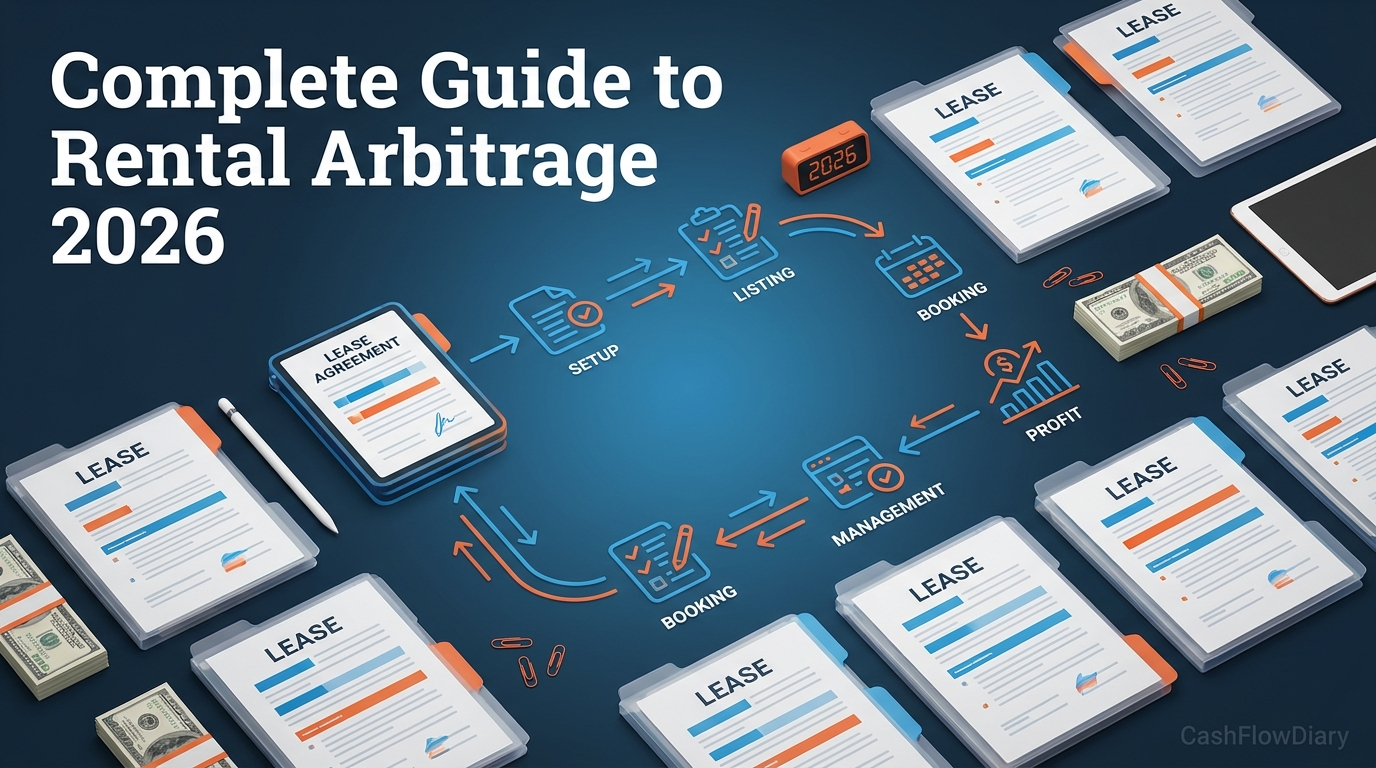
The business model has four steps. Every unit I've ever operated followed this same flow.
Step 1: Find the Right Property
Not every rental property works for short-term rental arbitrage. You're looking for units that:
Allow STR use (or landlords who are open to it after a conversation)
Are in a market with strong short-term rental demand
Have a rent level that leaves margin for profit after STR revenue
Are furnished or can be furnished cost-effectively
The best hunting grounds are Zillow, Craigslist, Furnished Finder, and direct outreach to property management companies. Corporate extended-stay apartments are often the most open to this model — landlords already understand short-term tenancy.
Step 2: Negotiate the Master Lease
This is where most beginners stop — and where the real opportunity lives.
A master lease is a long-term lease agreement between you (the operator) and the landlord. The key difference from a standard residential lease is the STR permission clause that explicitly authorizes you to list the unit on short-term rental platforms.
We'll spend an entire section on the landlord conversation in Section 4. For now: the lease is the legal foundation of your business. Get it in writing. Every time.
Step 3: Furnish and List
Once you have a signed lease with STR permission, you furnish the unit and create your listing. Furnishing for STR is an art — you need functional, photogenic, and durable. Not expensive.
A well-furnished 1-bedroom can be done for $3,000-$5,000 using IKEA, Amazon, and Facebook Marketplace. A 2-bedroom runs $5,000-$8,000 for a lean setup.
Your listing quality determines your revenue ceiling. Professional photos, a compelling title, and optimized pricing tools (more on this in Section 5) are what separate $2,800/month from $4,500/month on the same unit.
Step 4: Manage and Profit
Once you're live, the business is managing guest experience, optimizing pricing, and maintaining the property. With the right automation tools, a single operator can run 5-10 units without it becoming a full-time job.
The margin math on a single mid-market unit:
Monthly lease: $1,800
Platform fees (approx 15%): ~$525 on $3,500 in bookings
Cleaning costs: ~$200-300/month
Supplies/maintenance: ~$100/month
Net profit: $875-$1,300/month per unit
Stack five units like this and you're at $4,375-$6,500/month in net profit — from leases, not mortgages.
The Numbers — Is Rental Arbitrage Profitable?
Let's run the real math. I'm going to show you three scenarios: conservative, moderate, and aggressive. All based on a single 1-bedroom unit in a mid-market city.
Conservative Scenario — Slow Start, Weaker Market
Monthly rent: $1,600
Average nightly rate: $110
Occupancy: 55%
Monthly STR revenue: ~$1,815
Platform fees (15%): -$272
Cleaning (8 cleanings × $50): -$400
Supplies/maintenance: -$100
Monthly profit: -$157 (break even at ~60% occupancy)
The conservative scenario is why market selection matters. A 55% occupancy rate in a weak market barely covers costs. This is not where you want to operate.
Moderate Scenario — Solid Market, Good Execution
Monthly rent: $1,800
Average nightly rate: $135
Occupancy: 68%
Monthly STR revenue: ~$2,754
Platform fees (15%): -$413
Cleaning (10 cleanings × $55): -$550
Supplies/maintenance: -$100
Monthly profit: ~$891
This is what a well-run unit in a real market looks like. Not glamorous — but $891/month × 5 units = $4,455/month in net profit before scaling efficiencies kick in.
Aggressive Scenario — Strong Market, Optimized
Monthly rent: $2,000
Average nightly rate: $175
Occupancy: 78%
Monthly STR revenue: ~$4,095
Platform fees (15%): -$614
Cleaning (12 cleanings × $65): -$780
Supplies/maintenance: -$125
Monthly profit: ~$1,576
High-demand markets — think Nashville, Scottsdale, Austin, any tourism corridor — can push these numbers further with premium positioning.
What About Slow Months?
Seasonality is real. Most STR markets have 2-3 slower months per year. The operators who survive this are the ones who:
Negotiated a lease they can sustain on 55% occupancy
Built an emergency fund of 2-3 months' rent before launching
Used dynamic pricing tools that automatically drop rates to maintain occupancy during shoulder season
Diversified across multiple units so slow months in one don't sink the business
The 'what if the unit sits empty' fear is real — but it's also a math problem, not a mystery. Price correctly, target the right market, and know your occupancy floor before you sign the lease.
How to Find Landlords Who Will Say YES
This is CFD's real edge. I've had this conversation hundreds of times. Here's what I've learned.
Most landlords say no by default — not because the idea is bad, but because no one has taken the time to understand their actual concerns and address them directly.
The 3 Landlord Personas
Not all landlords are the same. The pitch that works for one will fail with another.
The Skeptic. They've heard 'STR' and immediately think of party houses and property damage. Their fear is not financial — it's about losing control of their property. They need reassurance and proof before money even enters the conversation.
The Pragmatist. They're a small-scale investor with 1-4 units. They care about reliable rent, zero vacancy, and no maintenance headaches. They'll listen to numbers — but only after they believe you're a professional operator, not a fly-by-night scheme.
The Portfolio Operator. They own 20+ units, possibly through a management company. They're most likely to already know what rental arbitrage is. They'll make the decision based on financial modeling and your track record.
What Landlords Fear
Noise complaints from neighbors
Property damage beyond normal wear and tear
HOA violations or lease complications
Insurance liability from guest injuries
Loss of control over who occupies their property
What Landlords Actually Want
Guaranteed rent on the 1st — no chasing
A professional operator who maintains the property better than a long-term tenant
Zero vacancy headaches
Someone who self-manages and doesn't call about every light bulb
Here's the thing most beginners miss: you are not asking a landlord to take a risk. You are presenting an offer that solves their actual problems.
The 3-Part Pitch Framework
1. Reassure. Address their fears before they voice them. 'I know your first concern is probably noise and property damage — here's exactly how I handle that.'
2. Prove. Show professionalism. Have a business entity (LLC), a website, insurance documentation, and references from other landlords if you have them.
3. Propose. Give them a concrete offer: guaranteed monthly rent, a damage deposit above standard, a professional cleaning service on record, and a STR permission addendum drafted in plain language.
The Lead Magnet: Landlord Approval Script
I put together the exact word-for-word scripts I've used — the email outreach, the phone follow-up, the in-person pitch, and the objection handlers. It's a 2-page PDF you can download and use this week.
[Download the Landlord Approval Script — free PDF →]
Setting Up Your First STR — From Lease to Live Listing
You have a signed lease with STR permission. Now you build the business.
Furnishing on a Budget
The goal is photogenic, functional, and durable. Not expensive.
For a 1-bedroom unit, target budget:
Bed frame + mattress: $400-600 (Zinus or similar from Amazon)
Bedding + pillows (hotel quality): $150-200
Sofa: $300-500 (IKEA KIVIK or equivalent)
Kitchen essentials (full set): $200-300
Towels and bath supplies: $100
Smart TV + streaming stick: $150-200
Desk + chair: $150-250
Total 1BR: $1,450-2,150 baseline
Add 40-60% for a 2-bedroom. Use Facebook Marketplace for sofas and accent pieces — many hosts sell used STR furnishings at steep discounts when they exit the market.
Listing Optimization Basics
Your listing title determines click-through rate. Your photos determine booking rate. Your description handles objections.
Title formula that works: [Vibe] + [Location Anchor] + [Standout Feature]
Example: 'Sunlit Downtown Studio | Walk to Convention Center | Fast WiFi + Netflix'
Photos: Hire a real estate photographer for your first unit. $150-250. It pays back 10x in higher ADR and occupancy. Every photo should be wide-angle, bright, and shoot toward the best feature in the room.
Pricing Strategy
Dynamic pricing is non-negotiable at scale. Static pricing leaves 20-35% revenue on the table. The two tools I recommend:
PriceLabs — algorithmic dynamic pricing with market data integration. ~$20/month per listing.
Hospitable (formerly Smartbnb) — automation for messaging, reviews, and task management. ~$15/month per listing.
Start with PriceLabs set to 'Recommended' and let it run for 30 days before adjusting. Most beginners over-manage pricing early and under-optimize later.
Platform Choice: Airbnb vs. VRBO vs. Both
List on both. Always.
Airbnb has broader reach and more first-time travelers. VRBO skews toward families and longer stays. The 15-20% commission overlap is worth the incremental bookings, and most automation tools sync calendars across platforms to prevent double-bookings.
Airbnb's Policy on Rental Arbitrage
Airbnb's host terms of service do not prohibit rental arbitrage. They require hosts to have permission from any relevant parties — which means your landlord's written permission in your lease covers the platform compliance requirement. Many professional hosts run 10, 20, 50+ arbitrage units on Airbnb successfully.
Local STR Permit Requirements
Before listing, check your city's short-term rental permit requirements. Most major markets fall into one of three categories:
Permissive: Registration required, but approved automatically with basic compliance (smoke detectors, etc.)
Moderate: Permit required, capped at a fixed number of permits in some zones, some neighborhoods excluded
Restrictive: Full ban in some areas, owner-occupancy requirements in others
Check your city's official STR portal. When in doubt, call and ask. The $50 permit is always better than the $2,000 fine.
Scaling Beyond One Unit
Here's how I went from 1 unit to 10 to 100+.
The first unit is hardest. You're figuring out the landlord pitch, the furnishing workflow, the listing optimization, the guest management. Everything is new.
By unit 3, the system is mostly built. By unit 5, you're mostly managing the system, not building it.
Systematizing the Landlord Acquisition Funnel
At scale, landlord outreach is a sales funnel — not a one-off conversation. The operators who grow fastest treat it that way.
Top of funnel: Identify 20-30 target properties per market using Craigslist, Furnished Finder, and property management company websites
Outreach: Send the email script from the Landlord Approval Script PDF to all 20-30 targets simultaneously
Follow-up: Phone call within 48 hours to anyone who opens the email or responds
Conversion: In-person walkthrough with the lease addendum ready to sign
Expect a 10-20% yes rate on cold outreach. That means 2-4 signed leases per 20 targets. That's a solid pipeline.
Building a Team
The first hire is always a cleaner — ideally a cleaning lead who manages a team and can handle multiple properties on turnover days.
At 5 units, bring on a virtual assistant to handle guest messaging. At 10 units, you need an on-the-ground co-host or property manager who can handle physical issues.
The goal is to build a business that runs without you in the day-to-day. That's when rental arbitrage becomes a wealth vehicle, not a job.
The Hybrid Path
Rental arbitrage generates cash flow. Cash flow, saved and deployed correctly, becomes the down payment for your first owned property. That's the path I took. Arbitrage first — buy with the profits.
Common Mistakes Beginners Make
Mistake 1: Picking the Wrong Market
The most common — and most expensive — mistake. STR demand is not uniform. A 68% occupancy rate in Nashville does not exist in every mid-sized American city. Research your market before signing a lease. AirDNA's market data (free tier available) will show you average occupancy, ADR, and seasonal patterns before you commit.
Mistake 2: Under-Pricing to 'Get Reviews Fast'
New hosts often price 30-40% below market to fill their calendars quickly. This damages your revenue per booking and trains the algorithm to categorize you as a budget listing. Instead: price at market for your first 3-5 bookings, deliver a great experience, and earn your reviews at full rate.
Mistake 3: Not Reading the Lease
Your lease is your business foundation. Read every clause. Specifically look for: subletting prohibitions (standard — you need an addendum), HOA rules (can override your lease rights), noise ordinances, and guest occupancy limits. A lease you haven't read is a business risk you haven't evaluated.
Mistake 4: Skipping the Landlord Relationship
Your landlord is a business partner, not just a payee. The operators who hold their leases through market downturns, regulatory changes, and property issues are the ones whose landlords trust them. Check in quarterly. Pay early. Communicate proactively about any guest issues before the landlord hears from a neighbor. A good landlord relationship is a moat.
Mistake 5: No Automation = Burnout
Manual guest messaging, manual pricing, manual calendar management — this is how operators with 3 units feel like they have 30. Get Hospitable or a similar tool on day one. Automate the check-in instructions, the review requests, the turnover scheduling. The $35/month it costs will save you 20 hours/month within the first 60 days.
Frequently Asked Questions
Is rental arbitrage legal?
Yes, when you have the landlord's written permission and comply with your local STR permit requirements. The key document is the STR permission clause in your lease addendum. Without that in writing, you're subletting — which is illegal under most standard lease agreements. With it, you're operating a licensed hospitality business.
How much money do you need to start rental arbitrage?
You can start a single unit for $3,000-$5,000 in most markets. This covers: first month's rent + security deposit (approx $3,600 on a $1,800/month lease), basic furnishing ($1,500-$2,200), professional photos ($200), and 30 days of operating reserves. A more comfortable launch budget is $7,000-$10,000 for a 1-bedroom unit, giving you cushion while you ramp up bookings.
Can you do rental arbitrage on Airbnb?
Yes. Airbnb's terms of service require hosts to have permission from any relevant parties — including landlords. If your lease addendum explicitly permits short-term rental use, you are compliant with Airbnb's requirements. Many professional hosts operate dozens of arbitrage units on Airbnb. The platform is built for this use case.
Is rental arbitrage profitable?
Yes, in the right markets with the right execution. A well-positioned unit in a solid STR market can net $800-$1,600/month in profit above lease costs. The key variables are: average daily rate in your market, achievable occupancy rate, and your lease cost. Run the numbers before you sign. If the math doesn't work at 60% occupancy, the market isn't right for this approach.
What is the difference between rental arbitrage and subletting?
Subletting is renting your space to another tenant without your landlord's knowledge or permission. It typically violates standard lease agreements and can result in eviction. Rental arbitrage is a commercial arrangement where you lease a property from a landlord with their explicit written permission to operate it as a short-term rental business. The landlord knows, agrees, and signs the addendum. That written permission is the entire legal difference.
Do I need an LLC to do rental arbitrage?
You don't need one on day one, but I strongly recommend forming an LLC before you sign your first lease. It separates your personal assets from business liability, gives you a more professional presentation to landlords, and simplifies tax reporting. A single-member LLC costs $50-$500 to form depending on your state and can be done online in under an hour.
Ready to Start? Here's Your Next Step
You now have the complete map: what rental arbitrage is, how the numbers work, how to find landlords who say yes, how to set up your first listing, and how to scale.
The only thing left is the landlord conversation — and that's where most people get stuck.
So I put together the exact scripts I've used across 400+ units: the email outreach, the phone follow-up, the in-person pitch, and the four most common objections with word-for-word responses.
It's free. Download it below.
→ [Download the Landlord Approval Script — Free PDF]
If you're ready to go deeper — the full launch system, the market selection framework, the furnishing workflow, and the first 90 days of operations — that's what the Rental Arbitrage Starter Course covers. At $67, it's the cost of one dinner. The ROI on one unit will pay it back in the first month.
→ [Get the Rental Arbitrage Starter Course — $67]
Start with the script. The rest follows.
— J. Massey