The operators who fail at rental arbitrage don't fail because the math doesn't work. They fail because they sign a lease before they've done 3 hours of market research. I've watched people lose $8,000 on their first unit not because rental arbitrage is broken — but because they did the steps in the wrong order. This guide puts them in the right order.
What This Guide Actually Covers
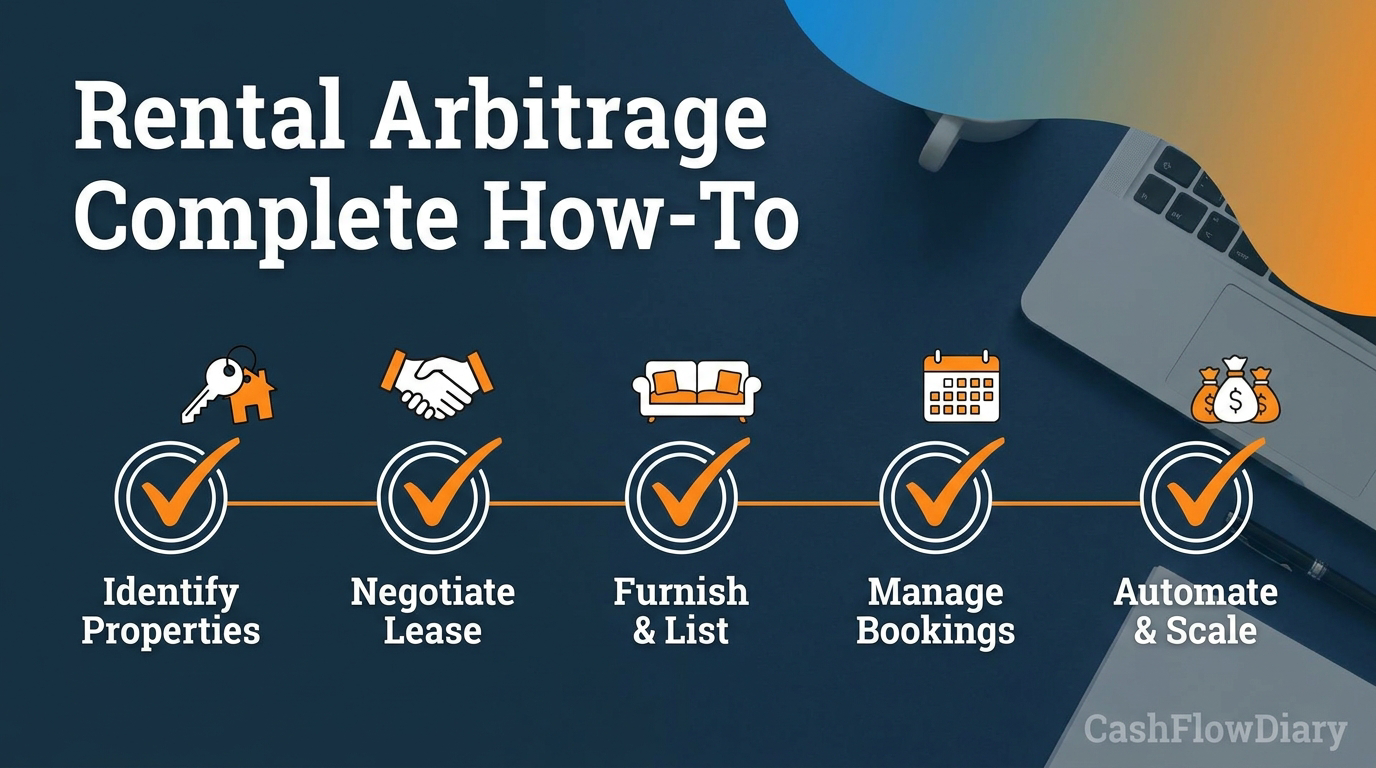
Most articles on rental arbitrage stop at "sign a lease and put it on Airbnb." That's not execution — that's a headline. This guide gives you the five-step operating sequence: market selection, property vetting, landlord pitch, financial model, and listing launch. By the end, you'll know whether your target market works, what to say to a landlord on a cold call, how to handle the three objections you'll always hear, and how to run the math before you sign anything.
The Misconception That Kills Most Arbitrage Operators Before They Start
Here's what most people get wrong: they treat rental arbitrage like a real estate deal, where the property is the decision. It's not. Rental arbitrage is a market arbitrage play — the property is just the vehicle. If you pick the wrong market, no amount of perfect landlord pitch or beautiful listing copy will save you. The lease cost is fixed. The STR revenue is variable. The spread has to work before you look at a single apartment.
I've seen operators launch in markets they chose because Airbnb looked busy when they visited for a weekend. Summer in a resort town, spring in a college city during graduation. They signed 12-month leases based on peak-week data and were hemorrhaging cash by November. Market first. Always.
Step 1: Choose Your Market (Before You Look at a Single Property)
The number one mistake new arbitrage operators make is falling in love with a property before they've validated the market.
Occupancy rate: Target markets where Airbnb occupancy runs above 60% year-round — not just a seasonal peak. Summer spike markets are traps. A market doing 80% in July and 25% in February does not support a 12-month lease obligation.
Average daily rate: Your gross revenue has to justify your lease cost by a comfortable margin. The baseline rule: your projected monthly gross at 60% occupancy needs to exceed your rent by at least $1,500 — and that's before cleaning fees, platform fees, and supplies. A $1,400/month lease needs to generate $3,000/month gross minimum to leave room to operate.
Regulatory environment: STR regulations move fast. Before signing a lease in any market, check whether the city requires a permit, whether permits are available to non-owner-occupied operators, and whether there's an active moratorium or pending legislation. I've seen operators commit to a 12-month lease in a market that passed an STR ban 60 days later. That's an avoidable loss.
Proximity rule for your first property: Start within 1-2 hours of where you live. I know operators who want to launch in Nashville or Scottsdale because the numbers look good on AirDNA. That's fine for property 3 or 4. For your first arbitrage unit, you need to be able to handle a guest lockout, a broken water heater, or a bad cleaning turnover without a flight. Stay close until you have systems.
Q: How do you choose a market for rental arbitrage?
A: For rental arbitrage, target markets with Airbnb occupancy rates above 60% year-round, average daily rates that generate at least double your monthly lease cost, and STR-friendly local regulations. Use AirDNA Market Minder to filter markets by occupancy, ADR, and revenue before committing to a lease.
Step 2: Find the Right Property
Once your market clears the screen, you're looking for a specific type of property with a specific type of landlord.
Target property types: standalone single-family homes or duplexes where landlords are individual owners, furnished corporate apartments where the landlord already understands the furnished short-stay model, and vacation-adjacent units where the owner has considered short-term rental themselves.
Where to find them: Furnished Finder is the single best source — landlords who list here are already STR-aware and far more receptive to an arbitrage conversation. Facebook Marketplace and local Facebook groups (search "furnished apartment for rent [city] subletting allowed") and Craigslist housing listings are also strong in secondary markets.
Red flags to walk away from: Leases with explicit no-subletting or no-Airbnb clauses, buildings with STR policy notices in common areas, and HOA-governed communities where the HOA bars STR.
Green flags: Landlords who own multiple units and think like investors, properties that have been vacant 60+ days (the landlord has a problem you can solve), and landlords who've mentioned "corporate rental" or "travel nurse" tenants in their listing.
Step 3: Pitch the Landlord (Word for Word)
This is the section most guides skip — or give you a useless summary like "just explain the benefits." Here's the actual framework, including the cold call opener I've taught to thousands of operators.
The cold call opener (from EP 607 on the CashFlowDiary Podcast):
"Hi, my name is [your first name]. My company and I are looking to lease a number of properties in the area. Are you the right person to talk to about that?"
That's it. One sentence. Notice what it does: it leads with "my company and I" — you're a business, not a random individual. It signals volume ("a number of properties") — the landlord hears a reliable, repeating tenant. And it hands them the wheel ("are you the right person") — they feel in control from the first exchange. The phone call goal is one thing only: book a site visit. Don't pitch the full model on the call.
When it comes to talking to landlords, their biggest problem is vacancy. You're not asking them for a favor. You're walking in with a solution to the problem that costs them money every month the unit sits empty.
The three objections you will hear:
Objection 1 — "My insurance doesn't cover short-term rentals." Your response: "I understand the concern. Airbnb's AirCover program provides up to $3 million in host liability protection and up to $3 million in property damage protection per stay — at no cost to you as the property owner. I also carry my own renter's insurance policy. I'm happy to connect you with an insurance broker who specializes in STR properties for an independent review."
Objection 2 — "I don't want strangers in my property." Your response: "Every guest on Airbnb goes through identity verification before booking. I also screen every reservation manually — I look at review history, verify purpose of stay, and I don't accept same-day bookings. I can share my house rules document with you so you know exactly what I require from guests."
Objection 3 — "Is this even legal?" Your response: "Yes, and I'll handle the permits. [City] requires an STR operator permit, and I'll pull it in my name before listing. I'll provide you a copy once it's approved. The permit is tied to the address — if I vacate, it stays with the property. That's actually an asset for you when you re-lease."
KNOW: 1 in 10 landlords will say yes to a subletting arrangement. The pitch is a volume game. Their biggest pain point is vacancy — lead with your ability to solve it.
DO: Send 20-30 outreach messages in your target market before concluding that the market doesn't work for arbitrage. Most operators give up after 5 rejections. The landlords who say yes are usually in your 15th to 25th outreach.
TRACK: Your outreach-to-call rate (target: 1 call per 10 outreach messages) and your call-to-signed-addendum rate (target: 1 signed deal per 3-5 calls).
Step 4: Run the Financial Model Before You Sign
This is the only number that matters at the lease-signing stage: is the spread big enough to absorb your costs and still produce monthly cash flow?
Sample deal: 2-bedroom unit in Phoenix, Arizona — based on AirDNA Market Minder data for Q1 2026:
Q: How much can you make with rental arbitrage?
A: A well-run rental arbitrage unit in a mid-tier STR market can generate $600–$2,000/month in net cash flow after lease, cleaning, utilities, and platform fees. The Phoenix, Arizona model above nets $618/month on a $1,400 lease — a 2BR running at 65% occupancy at $195 average daily rate, based on AirDNA Market Minder Q1 2026 data. Markets with higher ADRs (Nashville, Scottsdale, Austin) push this number significantly higher.
At $618/month net on the conservative Phoenix model, you break even on startup costs (furniture, security deposit, first/last month — typically $6,000-8,000 for a 2BR) in 10-13 months. In a stronger demand market at $1,200-1,600/month net, break-even comes in 5-7 months.
Step 5: Launch Your Listing (And Get Your First Reviews)
Once you've signed the lease and the subletting addendum, the listing is the product. Here's where operators leave money on the table.
Photography: Professional photos are not optional. Listings with professional photography earn 20-30% more per year than listings with phone photos, according to Airbnb's internal research. Budget $250-400 for a professional real estate photographer. It pays for itself in the first 30 days.
Pricing: Do not use Airbnb's built-in Smart Pricing tool. It optimizes for occupancy, not revenue. Use PriceLabs or Wheelhouse from day one. These tools consistently outperform Airbnb's native pricing by 10-20% in revenue.
Your listing title formula: [Bed count] BR [Property type] | [Unique feature] | [Location proximity]. Example: "2BR Modern Condo | Fast WiFi + Workspace | 10 Min to ASU"
First-review strategy: Price 15-20% below comparable listings for your first 30 days. Respond to every message within 1 hour for the first month. Send a check-in message and a mid-stay check-in. Include a handwritten note in the unit on day one. Your first 5 reviews set the trajectory of your listing.
Your First 90 Days: The Milestones That Tell You It's Working
Days 1-30: First guests arrive. Your job is to be operationally excellent and learn. Every guest interaction tells you something about your house rules, your listing description, and your cleaning protocol. Refine as you go.
Days 31-60: Your first full revenue month. Pull your actual occupancy rate and compare it to your model. If you're hitting 55%+ in month 2, you're on track. If you're at 35%, you either have a pricing problem, a listing quality problem, or a market problem — in that order of likelihood.
Days 61-90: Decision point. I use three signals: net cash flow above $600/month consistently, occupancy above 60% in months 2 and 3, and guest review score above 4.7 stars. If all three are green, you have proof of concept. Start looking for property 2.
What the Experts Say About Rental Arbitrage at Scale
Zeona McIntyre, co-author of 30-Day Stay (BiggerPockets, 2022) and an arbitrage operator who scaled to 20+ units without owning property: "The operators who build sustainable arbitrage portfolios treat it like a business from day one — an LLC, a defined outreach process, and a landlord pitch they've rehearsed 50 times before they ever pick up the phone. The ones who treat it like a side hustle hit a wall at unit 2 or 3."
Avery Carl, author of Short-Term Rental, Long-Term Wealth and founder of The Short Term Shop, on market selection: "The biggest mistake I see in rental arbitrage is people going straight to the top-performing vacation markets — Destin, Florida or Gatlinburg, Tennessee level markets. Those markets are saturated and the lease rates are high. The real opportunity is in mid-size cities with business travel demand, medical centers, and universities. Occupancy is steadier and lease costs are lower."
Frequently Asked Questions
How much does it cost to start rental arbitrage?
Startup costs for a single rental arbitrage unit typically run $5,000-10,000. This includes first and last month's rent, a security deposit, furniture and furnishings (budget $3,000-5,000 for a 2BR), professional photography ($300-400), and initial supplies. Many operators fund this with personal savings; some use a 0% intro APR business credit card for the furniture purchase.
Do I need an LLC for rental arbitrage?
Not legally required in most states, but strongly recommended. An LLC separates your personal assets from liability exposure as a host. Formation costs $50-500 depending on state. Have a real estate attorney review your subletting addendum and operating structure before launch.
Can landlords kick you out if they find out you're doing Airbnb?
If you have a subletting addendum in writing as part of your lease, no — you have a legal agreement. Without written permission, the landlord can pursue lease termination for violating subletting terms. Written permission is non-negotiable.
Is rental arbitrage worth it in 2026?
Yes — the model still works in markets where the spread between lease cost and STR revenue is $600+ per month after expenses. The operators who fail are those who skip the market vetting step, sign leases in over-regulated markets, or underestimate their operating costs. Do the model before you sign anything.
What happens if Airbnb changes its policies for arbitrage operators?
Airbnb has restrictions on certain types of commercial hosting. The safest structure is one listing per LLC, with each LLC presenting as a legitimate hosting business. VRBO and Furnished Finder are also strong distribution channels and carry no policy restrictions on arbitrage operations — they're actually better fits for the corporate relocation market segment.
Ready to Stop Researching and Start Earning?
Rental arbitrage is a proven path to STR income without capital tied up in a mortgage. The gap between knowing the concept and running an operating business is systems — the right market criteria, the right landlord scripts, and the right financial model. The STR Blueprint gives you the complete system: market research process, landlord outreach templates, financial model spreadsheet, pricing playbook, and a community of operators who've already done what you're trying to do. If you're serious about building an STR business in the next 90 days, that's the next step.
Sources
AirDNA, "Phoenix Short-Term Rental Market Data," AirDNA Market Minder, Q1 2026. https://www.airdna.co/
Airbnb Newsroom, "AirCover for Hosts," Airbnb.com. https://www.airbnb.com/aircover-for-hosts
Airbnb, "How Professional Photos Improve Listing Performance," Airbnb Resources for Hosts. https://www.airbnb.com/resources/hosting-homes/a/how-to-photograph-your-listing-like-a-pro-2
Avery Carl, Short-Term Rental, Long-Term Wealth, BiggerPockets Publishing, 2021.
Zeona McIntyre and Sarah Weaver, 30-Day Stay, BiggerPockets Publishing, 2022.
PriceLabs, "Dynamic Pricing for Short-Term Rentals." https://www.pricelabs.co/
Furnished Finder, "Furnished Rentals for Travel Professionals." https://www.furnishedfinder.com/
J. Massey, "Getting Landlords to Say Yes," CashFlowDiary Podcast EP 607, Feb 13, 2020. https://cashflowdiary.com/podcast/getting-landlords-to-say-yes