Table of Contents
Why Solo STR Operators Are Financial Martyrs
The Knowledge/Time vs. Money/Credit Partnership Formula
How to Find Partners Who Need What You Have
The Partnership Structures That Create Win-Win Wealth
Why Your Ego is Your Biggest Enemy to STR Success
The fastest path to STR wealth isn't working harder - it's working with the right people.
While solo operators are grinding 80-hour weeks trying to master everything from acquisition to automation, smart partnership operators are building empires by combining their strengths with other people's resources.
The myth of the "self-made" STR millionaire is destroying more wealth than it creates. Every successful STR empire was built through strategic partnerships - but the industry sells you the fantasy of doing it all yourself because that keeps you buying more courses, tools, and systems.
Today, I'm going to expose the solo operator lie and show you exactly how to find, structure, and profit from partnerships that multiply your results while reducing your workload.
But first, let me tell you about the business credit solution that turns you into the perfect partner for people with capital...
Sponsored by Fund & Grow
I've worked with Fund & Grow for 4-6+ years because they solve a critical partnership problem: accessing business credit so you can bring financing to the table. When you can secure $200K+ in business credit, you become an attractive partner for people with STR knowledge, prime properties, or operational expertise.
Why Solo STR Operators Are Financial Martyrs
Solo STR operators have turned wealth building into a part-time job that pays full-time wages - badly.
The Jobs to be Done Framework reveals the fatal flaw: solo operators hire themselves to perform every business function, which means they hire mediocrity to handle specialized tasks that require expertise. When you try to be the acquisition expert AND the renovation specialist AND the marketing guru AND the operations manager, you become average at everything.
Design Thinking shows us that solo operators develop tunnel vision that prevents them from seeing opportunities that require collaboration. They optimize for independence rather than results, creating businesses that serve their ego more than their bank account.
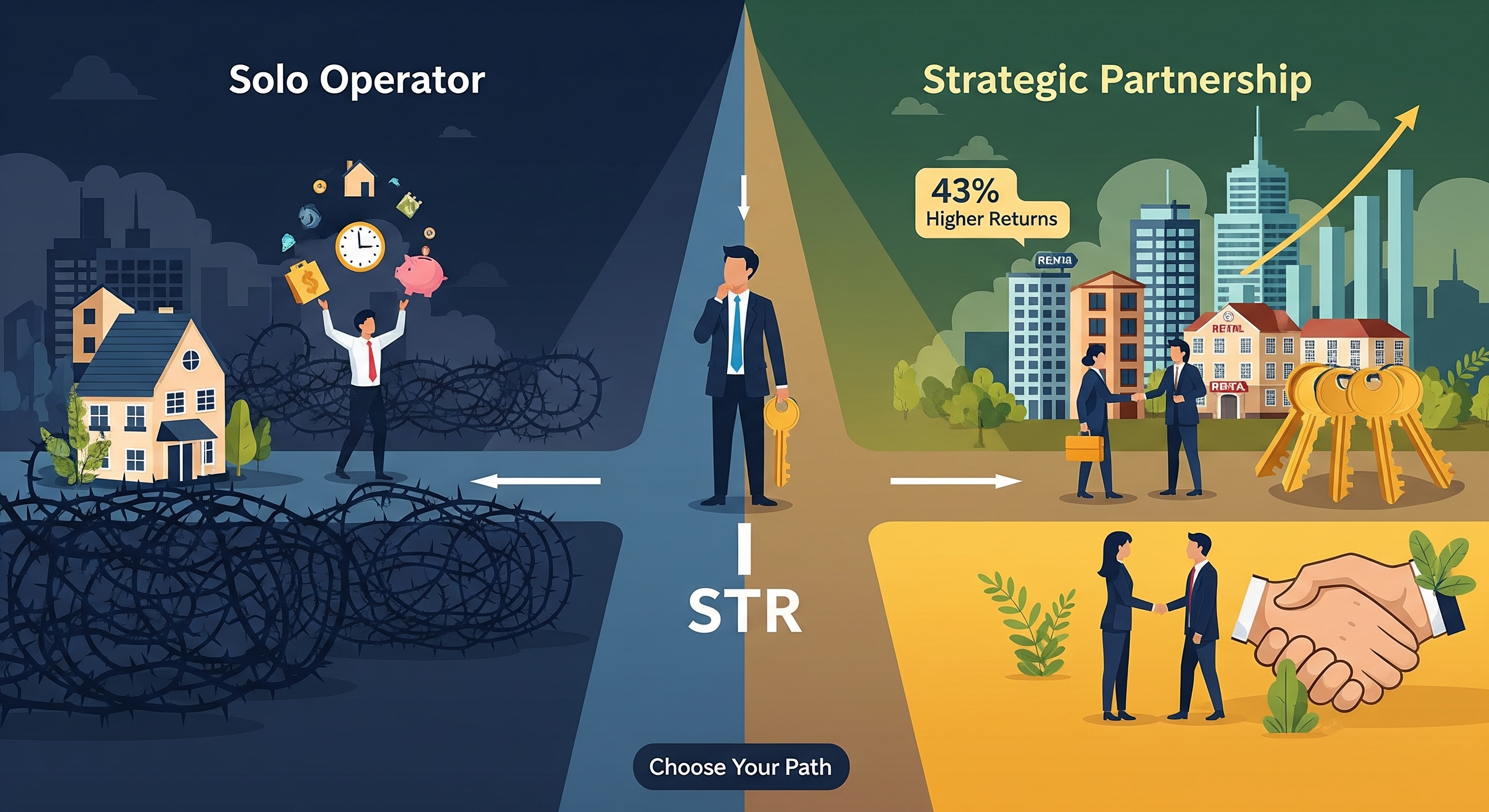
According to research from Stanford's Graduate School of Business, partnerships generate 43% higher returns than solo ventures in capital-intensive industries like real estate, proving that collaboration creates competitive advantages that independence can't match.
Here's why solo operations limit wealth instead of building it:
Resource Limitation Reality:
Solo operators can only move as fast as their personal capital allows
They're limited to markets they can personally research and manage
Their growth rate depends entirely on their individual learning curve
They must master every skill rather than leveraging other people's expertise
Expertise Dilution Problem:
Trying to excel at acquisition, renovation, marketing, and operations simultaneously
Becoming adequate at many things instead of exceptional at one thing
Missing opportunities that require specialized knowledge in multiple areas
Building systems based on personal limitations rather than market possibilities
Risk Concentration Issues:
All financial risk concentrated in one person's creditworthiness
Business success dependent on one person's health, motivation, and availability
No backup systems when personal challenges interfere with operations
Limited perspective leading to repeated mistakes that partners could prevent
Scaling Impossibility:
Physical time constraints limit the number of properties one person can manage effectively
Personal capital limitations create acquisition bottlenecks
Individual skill gaps prevent entry into lucrative but complex opportunities
Solo decision-making lacks the diverse perspectives that prevent expensive mistakes
Your Quick Win: Identify one area of your STR business where a partner could 10x your results - that's your starting point for partnership development.
The Knowledge/Time vs. Money/Credit Partnership Formula
The most profitable partnerships in STR match operators who have knowledge and time with investors who have money and credit.
The Jobs to be Done Framework shows us that successful partnerships hire complementary resources to create complete solutions that neither party could achieve alone. Knowledge/time operators and money/credit operators solve each other's biggest problems.
Design Thinking teaches us to develop empathy for what each type of partner actually needs and values. Knowledge operators need capital to scale their expertise, while capital operators need expertise to deploy their resources profitably.
As Henry Ford understood when building the auto industry through strategic partnerships:
"Coming together is a beginning, staying together is progress, and working together is success."
Ford didn't try to manufacture every component himself - he created partnerships that allowed specialists to excel at what they did best.
Research from Harvard Business School indicates that resource-complementary partnerships achieve 67% higher success rates than resource-competitive partnerships, proving that different strengths create stronger alliances than similar capabilities.
Here's how the knowledge/time vs. money/credit formula creates wealth:
Knowledge/Time Operator Advantages:
Understand markets, operations, and guest satisfaction from hands-on experience
Have time to research opportunities, manage properties, and optimize performance
Possess skills in acquisition, renovation oversight, marketing, and guest relations
Can provide sweat equity that reduces operational costs and increases profit margins
Money/Credit Operator Advantages:
Access to capital for property acquisition and improvement projects
Credit capacity for leveraging opportunities and scaling portfolios
Financial resources for handling unexpected expenses and market opportunities
Investment capital that can be deployed quickly when opportunities arise
Partnership Synergy Creation:
Knowledge operators provide expertise that prevents expensive mistakes
Money operators provide capital that accelerates growth beyond individual limitations
Time operators handle day-to-day management that capital operators don't want to do
Credit operators enable deal structures that knowledge operators couldn't access alone
Mutual Value Exchange:
Knowledge/time operators get access to opportunities beyond their personal capital
Money/credit operators get expertise that ensures their capital generates returns
Both parties achieve faster growth than either could accomplish independently
Risk is shared rather than concentrated in one person's resources or decisions
Your Quick Win: Write down exactly what you bring to a partnership and what you need from a partner - this clarity is essential for finding the right match.
Ready to find your ideal STR partner?
How to Find Partners Who Need What You Have
The best partnerships aren't found - they're identified through systematic understanding of what different types of people need and where they congregate.
The Jobs to be Done Framework reveals that successful partner identification requires understanding what job potential partners are trying to hire someone to perform. You're not looking for partners - you're looking for people who need your specific capabilities.
Design Thinking shows us that partner identification requires developing empathy for different types of investors and understanding their motivations, fears, and decision-making processes.
According to research from the Kauffman Foundation, 78% of successful business partnerships form through industry-adjacent networking rather than direct competitor connections, proving that effective partner search requires looking beyond obvious STR circles.
Here's where to find different types of partners who need what you offer:
Money/Credit Partners with STR Interest:
Real estate investment clubs and meetups (people with capital seeking opportunities)
Local REIA (Real Estate Investment Association) meetings
Business networking groups in affluent areas
Private lending circles and hard money lender referral networks
Successful small business owners looking for passive investment opportunities
Professionals with Capital but No STR Knowledge:
Medical professionals (doctors, dentists, specialists) with high income but limited time
Tech workers and executives with stock option windfalls
Legal professionals with partnership distributions seeking diversification
Financial advisors and CPAs who understand investment but not STR operations
Corporate executives nearing retirement with 401k rollover opportunities
Existing Real Estate Investors Seeking STR Expertise:
Traditional rental property owners interested in STR conversion
Fix-and-flip investors looking for buy-and-hold exit strategies
Commercial real estate investors seeking residential diversification
Wholesalers who want to keep deals rather than just assign them
Property managers with investor clients seeking new opportunities
Partner Identification Strategies:
Attend events where your ideal partners gather, not just STR events
Join online communities focused on investment and wealth building
Network with professionals who serve high-net-worth individuals
Build relationships with people who have the resources you need
Provide value first by sharing knowledge before seeking partnerships
Your Quick Win: Identify 3 places where people with money/credit but no STR knowledge congregate in your area - visit one this week.
The Partnership Structures That Create Win-Win Wealth
The wrong partnership structure destroys relationships and profits, while the right structure creates alignment that builds long-term wealth for everyone involved.
The Jobs to be Done Framework shows us that partnership structures must hire fairness to ensure long-term success. When partners feel the arrangement is equitable, they're motivated to maximize collective results rather than individual advantage.
Design Thinking teaches us to create partnership agreements that consider different partner motivations, risk tolerances, and contribution types. Successful structures align incentives so that individual success drives collective success.
As Warren Buffett explained about his successful partnership philosophy:
"It's better to hang out with people better than you. Pick out associates whose behavior is better than yours and you'll drift in that direction."
Buffett understood that successful partnerships require structures that benefit all parties and encourage everyone's best performance.
Research from MIT's Sloan School of Management shows that equitably structured partnerships achieve 89% higher longevity and generate superior returns compared to partnerships with unbalanced benefit allocation.
Here are partnership structures that create sustainable success:
50/50 Equity Partnership:
Equal ownership and decision-making authority
Shared profits, losses, and operational responsibilities
Works best when partners contribute roughly equal but different value
Requires strong communication and conflict resolution systems
Investor/Operator Split (70/30 or 60/40):
Capital partner provides funding and gets majority equity
Operating partner manages properties and gets minority equity plus management fees
Capital partner receives preferred returns before profit sharing
Operating partner receives sweat equity and operational control
Fee-for-Service Plus Equity:
Operating partner receives management fees for ongoing operations
Capital partner receives preferred returns on invested capital
Both parties share in appreciation and cash flow above target returns
Provides operating partner with immediate income plus long-term wealth building
Joint Venture by Property:
Partners collaborate on specific properties rather than creating ongoing entity
Allows testing of partnership dynamics before larger commitments
Each property can have different terms based on specific contributions
Provides flexibility for partners with varying involvement levels
Master Lease Arrangements:
Operating partner leases properties from capital partner at fixed rates
Operating partner receives all revenue above lease payments
Capital partner receives guaranteed returns with limited operational involvement
Reduces capital partner risk while providing operating partner with control
Your Quick Win: Research 3 different partnership structures and identify which fits your situation and partner type best.
Structure partnerships for success.
Why Your Ego is Your Biggest Enemy to STR Success
The most expensive word in STR is "I" - as in "I can do this myself."
The Jobs to be Done Framework reveals that ego hires independence to avoid the vulnerability of depending on others, but this protection comes at the cost of limiting growth to what one person can achieve alone.
Design Thinking shows us that ego prevents the empathy required for effective partnerships. When you're focused on maintaining control and credit, you can't develop the understanding of others' needs that creates mutually beneficial relationships.
According to research from the Journal of Business Psychology, ego-driven decision making reduces business performance by 31% compared to outcome-driven decision making, proving that prioritizing control over results limits success.
Here's how ego destroys STR wealth building:
Control Addiction Problems:
Refusing partnerships that would accelerate growth because they require sharing decisions
Trying to master every aspect of STR instead of leveraging other people's expertise
Avoiding opportunities that require admitting you need help or resources
Building businesses that serve your need for control rather than market opportunities
Credit and Recognition Obsession:
Wanting to be known as the person who "did it all themselves"
Avoiding partnerships because success would have to be shared
Making decisions based on how they'll look rather than how they'll perform
Building wealth more slowly to maintain the narrative of self-reliance
Fear of Vulnerability in Relationships:
Avoiding partnerships because they require trusting other people
Trying to minimize dependence on others even when it limits results
Creating complex structures to maintain control rather than simple structures that work
Sabotaging potentially profitable relationships to avoid feeling dependent
Opportunity Cost of Ego:
Missing deals that require partners or collaboration
Limiting growth rate to personal capacity rather than market opportunity
Building smaller businesses that serve ego rather than larger businesses that serve wealth
Choosing independence over income when the two conflict
Ego vs. Wealth Reality Check:
Successful partnerships require checking ego in favor of checking bank accounts
The goal is wealth building, not independence building
Other people's success doesn't diminish your success when structured correctly
The fastest wealth builders leverage other people's strengths rather than trying to develop their own in every area
Your Quick Win: Identify one business decision you made based on ego rather than profit - how could a partner have helped you achieve better results?
Check your ego, grow your wealth.
The Partnership Wealth Reality
Here's what separates STR millionaires from STR strugglers: they understood that the goal isn't independence - it's wealth.
They realized that trying to do everything yourself doesn't make you self-reliant - it makes you income-limited. They discovered that sharing success with the right partners creates more wealth than trying to keep 100% of smaller results.
While solo operators are perfecting their systems for managing 3-5 properties, partnership operators are building systems for managing 20-50 properties by combining their operational expertise with other people's capital and credit.
The operators consistently hitting $800+ per bedroom targets aren't trying to prove they can do everything themselves - they're proving they can find the right people to do everything better together. They've mastered the art of:
Identifying what they do exceptionally well and finding partners who excel at everything else
Creating structures that align everyone's interests toward collective wealth building
Building relationships based on mutual value rather than personal neediness
Scaling through collaboration rather than limiting growth to personal capacity
Your ego wants you to succeed alone. Your bank account wants you to succeed with others.
The choice is simple: independence or income. Control or cash flow. Recognition or results.
Partnership isn't about finding people to help you. It's about finding people to succeed with. It's not about sharing your success - it's about creating success that's too big for one person to achieve alone.
The STR operators who build lasting wealth don't try to do everything themselves - they try to find the best people to do everything together.
P.S. Ready to find the perfect STR partner and structure a win-win deal? I've helped hundreds of operators realize that their biggest limitation isn't lack of knowledge or capital - it's lack of strategic partnerships. Let's talk strategy and identify exactly what type of partner you need and where to find them.
The operators who scale fastest aren't the most independent - they're the most collaborative. The goal isn't self-reliance - it's wealth creation.
Who will you build wealth with?
Want more strategies for finding and structuring profitable STR partnerships? Join thousands of operators getting collaboration-focused strategies that prioritize wealth building over ego building.