TL;DR: Travel nurses need furnished housing for 13-week assignments, backed by tax-free housing stipends pegged to federal GSA rates. For property owners, this model delivers higher monthly rent than traditional leases with predictable turnover. Price to the local stipend, furnish for function, list on Furnished Finder, and manage vacancy like you planned for it.
What you need to know:
300,000+ travel nurses are active at any time, each needing furnished housing for roughly 13 weeks
85% receive non-taxable housing stipends ranging from $1,200/month to $4,000+/month based on location
Furnished mid-term rentals consistently earn $500–$800/month more than unfurnished long-term leases in most markets
Dominant listing platform is Furnished Finder, built for 30+ day rentals and connected to 45,000+ nurses
Turnover is predictable, vacancy is budgetable, and the tenant pool is employed professionals motivated to protect their rental record
Most content on travel nurse housing gets written for the nurse. This one's for the property owner.
Between 2020 and 2022, the travel nurse population jumped 35%. Through 2033, there are 197,000 predicted registered nurse job openings per year. Only 177,440 new nurses are expected to enter the workforce by 2032.
The gap creates demand. Demand creates assignments. Assignments create housing need.
300,000+ travel nurses are working assignments at any given time. All of them need furnished housing for roughly 13 weeks. 85% of contracts include a tax-free housing stipend pegged to federal GSA per diem rates for the assignment location.
I've run properties in this model. The math works when you price to the stipend, furnish for function, and manage turnover like an operator instead of reacting to it like a landlord caught off guard.
Why Travel Nurses Work as Tenants
Travel nurses book 13-week furnished stays. The income is stipend-backed. They're employed professionals working 12-hour shifts at hospitals.
Turnover is predictable. Not random like nightly short-term rentals. Not locked in for 12 months like a traditional lease. The assignment runs 13 weeks, they leave, the next one arrives. You know the timeline before they move in.
They're educated, employed, and motivated to keep a good rental record. Bad reviews follow them. They need housing every 13 weeks for the rest of their career. The ones who trash a unit or skip out early get flagged in the community.
Repeat demand is built into the profession. The same nurse returns for another assignment in your market. They refer colleagues. One good placement compounds into three or four bookings without you listing the unit again.
Furnished Finder reports guests stay three or more months on average. Less turnover, less stress, steadier bookings than nightly platforms or month-to-month arrangements.
Turnover is one of the highest expenses of holding property long term. Travel nurses solve the turnover problem at a predictable cadence. You know when they're leaving. You know how long the next assignment will run. You list the unit before the current tenant moves out.
Key point: Travel nurses deliver predictable 13-week occupancy with stipend-backed income and professional conduct. The turnover cadence is knowable in advance, which removes the randomness from vacancy planning.
How Housing Stipends Work and How to Price Your Unit
This section separates operators who fill units from operators who guess and hope.
Housing stipends are pegged to federal GSA per diem lodging rates for the assignment location. For fiscal year 2026, the standard CONUS per diem rate is $178 per day: $110 for lodging, $68 for meals and incidentals.
The stipend is non-taxable to the nurse. If they spend less than the allotment, they keep the difference. They're not spending their own money. They're spending an allocation.
Reported ranges: roughly $1,200/month in low-cost-of-living markets to $4,000+/month in high-cost metros. Mississippi runs around $300/week (roughly $1,300/month). San Francisco runs around $1,000/week (roughly $4,300/month).
The pricing model for owners: look up the GSA per diem rate for your city. That's your price ceiling for what a nurse on stipend pays and still breaks even. Price your unit at or below that ceiling, all-in (rent + utilities + Wi-Fi). You capture the full stipend without pricing yourself out.
Concrete example from a property I run: a furnished unit near a hospital corridor in a mid-cost-of-living market prices at $2,200/month all-in. The GSA rate for that zip is $2,400/month. The nurse pockets $200. I fill the unit every 13 weeks with zero negotiation on price.
When you price to the stipend, price resistance nearly disappears. The question becomes "does this fit my stipend?" not "what's my personal budget?"
Stipends range from around $700 per week in lower-cost areas to $1,500 or more in high-demand cities, tied to cost of living and regional housing markets. California has the highest demand for travel nurses, driven by the state's large population and mandatory patient-nurse ratios. Other states with high demand include Texas, Georgia, Massachusetts, and New York.
Key point: Price to the local GSA per diem stipend, not to what you think the market will bear. The stipend is the ceiling and the anchor. Nurses are spending an allocation, not personal funds. All-in pricing at or below the stipend eliminates negotiation friction and fills units faster.
Furnished Mid-Term Rental vs. Long-Term Lease: Real Yield Comparison
Operator math. Not a guarantee.
Scenario: 1BR unit in a mid-cost-of-living market.
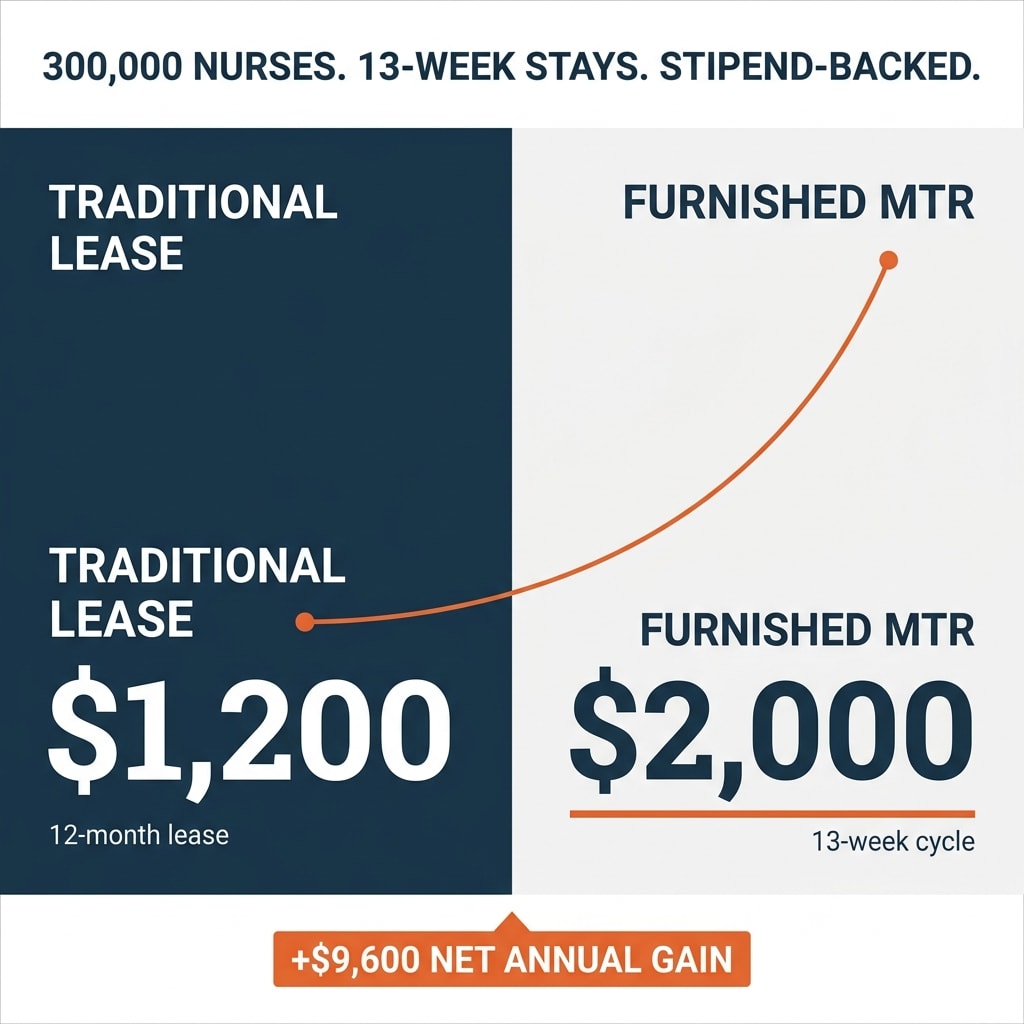
Long-term unfurnished: $1,200/month, 12-month lease, minimal turnover cost, low vacancy.
Furnished mid-term rental (travel nurse): $2,000–$2,400/month all-in (includes utilities roughly $150–$200/month, Wi-Fi roughly $50/month).
Net mid-term rental after costs: roughly $1,700–$2,000/month — still $500–$800/month more than long-term.
Furnishing cost: one-time $3,000–$6,000 for a quality furnished 1BR. Amortized over 12 months equals $250–$500/month off year-one net.
Vacancy gaps between assignments: budget 1–2 weeks per turnover. At 4 turnovers per year, that's 4–8 weeks of potential vacancy.
In most markets, a well-run furnished mid-term rental still nets more per month than a long-term lease. The margin depends on how tightly you manage vacancy and turnover cost.
A 3-bedroom property leasing at $2,800/month on a traditional lease commands $3,360–$3,920/month as a furnished rental. Part of that premium offsets utilities and internet, which the landlord covers. The net gain after those costs still produces more income, running 10–20% above traditional long-term rental net income.
The costs that eat the premium: furnishing depreciation, cleaning between assignments, utility carrying costs during vacancy, property management if you're not self-managing.
Short-term vacation rentals average 25–40% annual vacancy due to seasonal demand fluctuations. Mid-term rentals fall in the 10–15% range because tenants are booking for extended periods, not nights.
Key point: Furnished mid-term rentals to travel nurses consistently net $500–$800/month more than unfurnished long-term leases in most markets. The premium holds after accounting for furnishing amortization, utilities, and budgeted vacancy. The advantage comes from pricing to the stipend and managing turnover systematically.
Setting the Unit Up: What Travel Nurses Need
They're showing up with a suitcase, working 12-hour shifts, and need the place to function on day one.
Non-negotiables:
Queen or king bed with quality mattress
Blackout curtains (night shift workers sleep during the day)
Reliable high-speed Wi-Fi (charting, telehealth calls)
Washer/dryer in-unit (laundromats are a deal-killer)
Fully equipped kitchen (they're not eating out every meal on a 13-week stay)
Strong differentiators:
Not worth overspending on: premium finishes, smart home tech, luxury linens. A clean, functional, well-lit unit beats a staged Instagram property every time.
Practical furnishing budget: $3,000–$5,000 for a 1BR done right (IKEA + Amazon + one quality mattress). Don't buy cheap mattresses. Nurses sleep on them after 12-hour shifts and they will leave reviews about it.
Confirm what's included in the listing explicitly. Nurses vet this before committing.
Key point: Furnish for function, not aesthetics. Non-negotiables are a quality mattress, blackout curtains, reliable Wi-Fi, in-unit washer/dryer, and a fully equipped kitchen. Proximity to the hospital, a dedicated workspace, and parking are strong differentiators. Skip premium finishes and smart home tech.
Where to List: Furnished Finder, Facebook Groups, and Airbnb
Furnished Finder is the dominant platform built for travel-nurse and mid-term (30+ day) housing. No per-booking traveler fees. Owners set rent directly. Average stay runs around 3 months.
Founded in 2014, the platform was created to solve a problem general rental platforms never addressed: connecting short-term healthcare travelers with landlords who understand the 13-week contract model.
The platform connects 45,000+ nurses and 100+ medical staffing companies. 300,000+ listings across the U.S. from over 240,000 verified landlords. Over 6 million housing searches per month.
Free basic listing. Premium listing gets you into the notification network. When a nurse submits a housing request matching your listing, you're alerted.
Airbnb: larger audience, built for nightly stays. Monthly discount feature helps, fees are higher, and the audience is mixed. You'll get vacation travelers mixed with healthcare workers. Works as a secondary channel.
Zillow/Apartments.com: good for visibility, less nurse-specific. Better for longer-term furnished listings (2–6 months) than 13-week travel nurse cadence.
Facebook Groups: search "Travel Nurse Housing + [City]" — active, nurse-specific, zero platform fees. Takes more manual effort. Produces direct relationships with nurses and housing coordinators.
Recommendation: list on Furnished Finder first. Add Facebook groups for your metro. Use Airbnb as a fill channel between assignments if you have vacancy.
Key point: Furnished Finder is the primary listing platform for travel nurse housing. Free to list, no per-booking fees, and connected to the largest nurse and staffing agency network. Facebook groups and Airbnb work as secondary channels.
The Lease: 13-Week Fixed Term, Utilities, Early-Termination, Deposits
Standard travel nurse assignment equals 13 weeks. Some run as short as 4 weeks. Some extend. Build your lease around this.
Use a fixed-term lease matching the assignment length. Not month-to-month. It gives both parties clarity.
Utilities: include them in the rent (all-in pricing). This is what nurses expect and what makes your listing competitive. Separately metered utilities create friction and confusion.
Early-termination clause: this is where landlords get burned. If the nurse's assignment is canceled, you need protection. Include:
30-day written notice required
Forfeiture of security deposit if terminated early without 30-day notice
Option to re-list immediately upon notice
Some operators charge a flat early-termination fee (one month's rent).
Security deposit: collect one. 1–2 months' rent is standard. Nurses are motivated to keep this clean. It's a recurring expense across every assignment.
Compliance note: landlord-tenant law, lease terms, and mid-term rental rules vary by city and state. Verify local regulations and consult a professional before signing anything. This is educational, not legal advice.
Key point: Structure the lease as a fixed-term 13-week agreement with all-in pricing (utilities included). Include a clear early-termination clause with 30-day notice and deposit forfeiture if violated. Collect a 1–2 month security deposit. Verify local regulations before finalizing terms.
Finding Tenants Beyond Listing Platforms
Staffing agency housing coordinators: every major travel nurse staffing agency has a housing coordinator whose job is to help nurses find housing. Get your unit in front of them. Call the agency directly, introduce your property, ask to be added to their housing resource list. One relationship with a housing coordinator fills your unit for years.
Hospital housing resource pages: large hospitals maintain a list of landlord-approved housing for traveling staff. Contact the HR or staffing department.
Facebook groups: "Travel Nurse Housing + [City]" — post availability, respond to requests, build a reputation as a reliable landlord who understands the travel nurse cadence.
Nurse word-of-mouth: the travel nurse community is tight. One nurse who loves your unit tells two colleagues. Make the experience clean, easy, and responsive. Reviews and referrals compound.
Repeat bookings: after a successful placement, ask the nurse directly: "If you're back in this market, I'd love to host you again. Feel free to share this listing with colleagues." Simple. Works.
Most landlords need four tenants a year to stay fully booked. With the tenant base growing more diverse, hitting that number is easier than ever.
Key point: Build direct relationships with staffing agency housing coordinators and hospital HR departments. One coordinator relationship produces years of bookings. Nurse word-of-mouth compounds when you deliver a clean, responsive experience.
Is Mid-Term Right for Your Property?
Decision frame for operators scaling from 1 to 10 units.
Good fit:
Unit within 20–30 min of a major hospital or medical center
1BR or 2BR (2BR can command higher rates for nurses who bring a partner or want extra space)
Market with active healthcare employment
You can furnish and manage turnover systematically
Less ideal:
Rural markets with no hospital demand
Markets with heavy STR regulation that also restricts MTR (check local ordinances)
Properties where furnishing cost would take more than 18 months to recoup
The question: fill the unit at least 3 out of 4 assignment cycles per year? At 75% occupancy, the math beats long-term. Below 60%, you're breaking even or losing the premium.
Mid-term as a portfolio strategy: some operators run a mixed portfolio — 1–2 mid-term rental units near hospital corridors, the rest as standard short-term rental or long-term. The mid-term rental units provide cash-flow stability. The short-term rental units provide peak-season upside.
Key point: Mid-term rentals work best for properties within 20–30 minutes of a major hospital in markets with active healthcare employment. At 75% occupancy (3 out of 4 cycles filled), the model beats long-term leasing. Below 60%, the premium erodes.
Frequently Asked Questions
How do travel nurses find housing?
Two options: agency-placed housing (the staffing agency arranges it) or a housing stipend (the nurse receives a monthly allocation and finds housing independently). Most experienced nurses prefer the stipend — it gives them control and lets them pocket any difference.
What is a travel nurse housing stipend?
A non-taxable monthly payment from the staffing agency, pegged to federal GSA per diem lodging rates for the assignment location. Stipends range from roughly $1,200/month in lower-cost markets to $4,000+/month in high-cost metros. The nurse keeps any unspent amount.
How long do travel nurses rent for?
Most travel nurse assignments run approximately 13 weeks (one quarter). Some crisis contracts run as short as 4 weeks. Some nurses extend a successful assignment. Plan your lease and turnover budget around the 13-week standard.
Is renting to travel nurses worth it for landlords?
In most markets, yes — if the unit is furnished, near a hospital corridor, and priced to the local housing stipend. Furnished mid-term rental units regularly earn more per month than equivalent unfurnished long-term rentals, net of furnishing and turnover costs.
What is the best site to list travel nurse housing?
Furnished Finder is the dominant platform built for travel nurses and mid-term rentals. No per-booking fees for travelers, owners set rent directly, and the platform connects to 45,000+ nurses and 100+ staffing agencies.
What is a mid-term rental?
A furnished rental with a stay of 30+ days — longer than a nightly vacation rental, shorter than a standard 12-month lease. Travel nurse housing is the most common mid-term rental use case. Corporate relocations, insurance placements, and remote workers also use this model.
Key Takeaways
Travel nurses represent a predictable, stipend-backed tenant pool of 300,000+ active professionals needing furnished housing for 13-week assignments.
Price your unit to the local GSA per diem stipend (all-in: rent + utilities + Wi-Fi) to eliminate negotiation friction and capture the full allocation.
Furnished mid-term rentals consistently net $500–$800/month more than unfurnished long-term leases in most markets, after accounting for furnishing, utilities, and vacancy.
Furnish for function: quality mattress, blackout curtains, reliable Wi-Fi, in-unit washer/dryer, and fully equipped kitchen. Skip premium finishes.
List on Furnished Finder first. Build direct relationships with staffing agency housing coordinators and hospital HR departments for long-term tenant pipelines.
Structure leases as 13-week fixed terms with all-in pricing, clear early-termination clauses, and 1–2 month security deposits.
At 75% occupancy (3 out of 4 cycles filled), mid-term rentals beat long-term leasing. Below 60%, the premium erodes.
Next Steps
Want to model the mid-term numbers for your unit? That's what we do on a strategy call — run the yield comparison for your market, your property, and your current portfolio mix.
Book a diagnostic call at cashflowdiary.com/diagnostic.
For step-by-step instructions on listing your property, read the companion guide: How to List on Furnished Finder for Travel Nurse Tenants.
For broader context on short-term rental investing strategies, check out the STR investing pillar and STR tax pillar.
Educational only. Not legal or tax advice. Landlord-tenant law, lease terms, and short-term/mid-term rental regulations vary by city and state. Verify local regulations and consult a qualified professional before making any decisions.
Learn STR Operations the Right Way
Every operator I work with goes through this audit before we build the second channel, the second guest type, the second pricing model. If you want the full framework — the platforms, the compliance sequence, the pricing model that protects margins through regulatory shifts — that's what we map in the STR diagnostic.
Start your diagnostic →