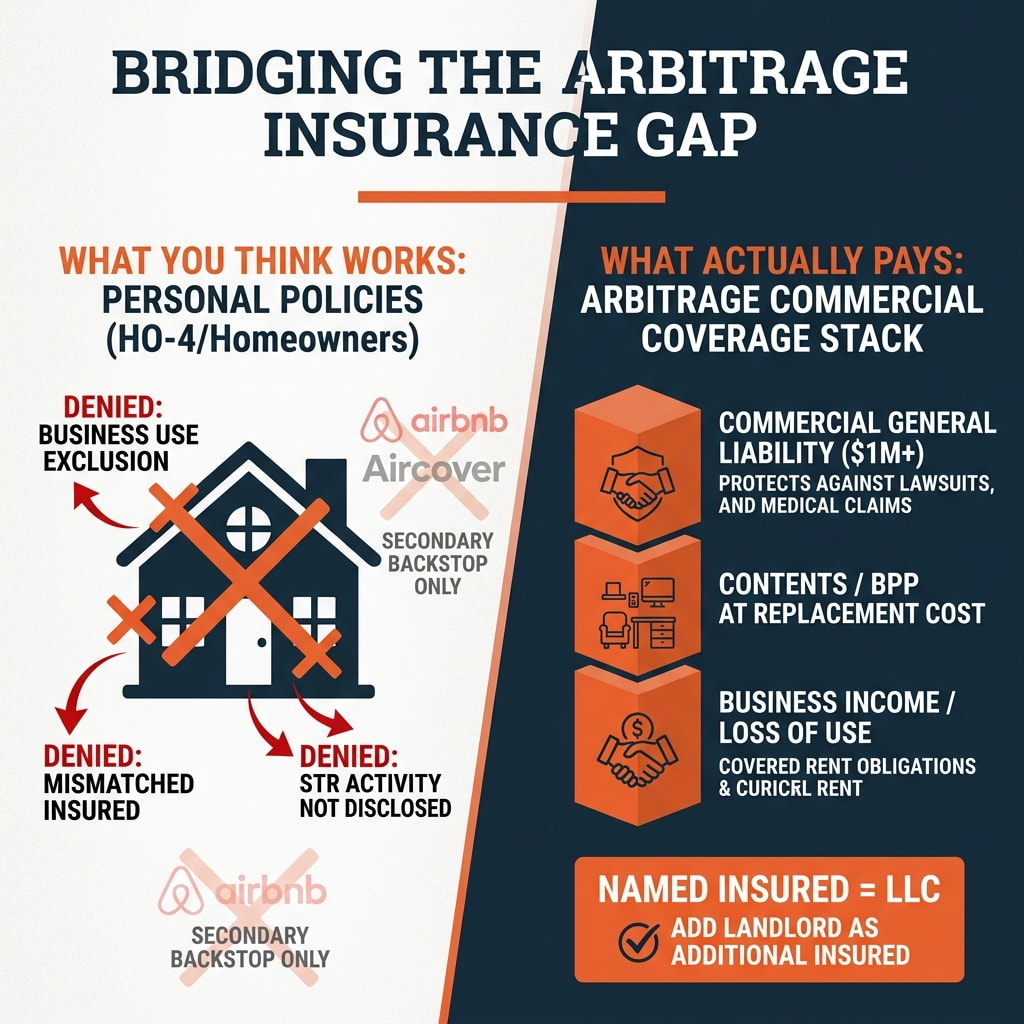
TL;DR: Standard renters and homeowners policies don't cover rental arbitrage. You need commercial STR insurance with three components: $1M+ liability, business personal property coverage at replacement cost, and business income protection. Platform programs like AirCover are secondary backstops, not primary coverage. Most claims get denied because of wrong named insured, undisclosed commercial use, lease violations, or coverage gaps.
Rental arbitrage operators find out their insurance doesn't work the same way: when filing a claim.
Guest slips on stairs. Pipe bursts, floods the unit. Cleaning crew quits, forcing you to cancel $12,000 in bookings. You file. Three weeks later: denial letter. Wrong policy type. Business activity exclusion. Named insured mismatch. Material misrepresentation.
The gap between what you think you're covered for and what your policy pays is where operations end.
Rental arbitrage sits in its own insurance category. You don't own the building. You're not a personal tenant. You're running hospitality out of someone else's property. Distinct risk profile. Distinct coverage stack.
Here's what you need, what voids it, how to set it up so the claim pays.
What Rental Arbitrage Operators Need
Three coverages. Not negotiable:
Commercial General Liability ($1M minimum per occurrence) for guest injuries and legal defense
Business Personal Property at replacement cost for your furniture, appliances, electronics
Business Income Coverage to pay your lease when the unit sits empty after a covered loss
Your operating LLC as named insured (not your personal name)
Landlord's written permission to sublet, documented in the lease or addendum
Why Standard Policies Don't Work for Arbitrage
Your landlord's policy covers the building and the landlord's interests. Not you. Not guests. Not your furniture.
Standard renters insurance covers personal use. The moment you host a paying guest, it's commercial activity. Carriers exclude it. Business use exclusion lets insurers deny claims at STR properties, even for fire or storm damage unrelated to guests.
Homeowners policies exclude STR activity for the same reason.
March 2026: the Insurance Information Institute published a report stating standard homeowners insurance doesn't cover commercial activities, including short-term rentals. Failing to notify insurers results in denied claims, reduced coverage, higher deductibles, or cancellation.
Emily Richer hosted on Airbnb. Tree fell on her property. $120,000 in damage. Homeowners insurer denied the claim: business activity exclusion.
You don't own the building. You're not a personal tenant. You're running hospitality. That's its own insurance category. Most operators don't find out until the denial letter arrives.
Key Point: Standard personal policies (renters, homeowners) exclude commercial STR activity. Arbitrage operators need commercial coverage designed for short-term rental operations.
Three Coverages Every Arbitrage Operator Needs
Three components in your commercial policy. Not one. Not two. All three.
Commercial General Liability (Minimum $1M Per Occurrence)
Covers guest injuries, slip-and-falls, legal defense. Frivolous lawsuits cost $300+ per hour in attorney fees.
Liability is your costliest exposure as an Airbnb host, often reaching or surpassing $1 million per occurrence. Defense costs alone run six figures. Negligence can't be waived. Courts allow claims to proceed when negligence is alleged, regardless of what guests signed.
Your second biggest liability exposure as a human (after driving a car) is now your STR. The U.S. is litigious. Slip-and-fall claims are the most common liability claims at vacation rentals.
Carry minimum $1 million. $2 million if your budget allows. At $700 to $1,500 per year for a single unit, it's cheap insurance against lawsuits and delisting.
Non-negotiable.
Business Personal Property at Replacement Cost
Covers your furniture, appliances, bedding, electronics. You bought it. You're responsible for it. Landlord's policy won't touch it.
Set the limit at replacement cost, not actual cash value. Actual cash value depreciates. Replacement cost pays what it costs to replace the item today. Guest destroys a $1,200 couch you bought two years ago? Replacement cost pays $1,200. Actual cash value pays maybe $600.
The difference matters when you're restocking a unit to get it back online.
Business Income Protection
Covered loss (burst pipe, fire, water damage) makes the unit unrentable for 90 days. You still owe rent to the landlord.
Business income coverage pays the gap between what you're collecting ($0) and what you owe (the lease obligation).
This is the coverage operators skip and regret. Guest's kitchen fire causes $25,000 in damage. You have $35,000 in confirmed bookings over eight weeks. You cancel. Repairs take 10 weeks. You're still paying the landlord $2,400/month while the unit sits empty.
Business income coverage pays that gap. Without it, you're writing checks out of pocket while the unit produces nothing.
Cost for all three coverages: $1,000 to $2,500 per year for a single unit. Varies by location, unit size, limits. Coverage terms, exclusions, pricing vary by carrier and jurisdiction. Confirm with a licensed agent before purchasing.
Treat it as a fixed operating cost. Not optional. If you're running numbers on a new unit and insurance doesn't fit the budget, the unit doesn't work. Build it into your startup cost model before you sign the lease.
Key Point: Commercial STR insurance costs $1,000 to $2,500/year per unit and must include liability ($1M+), business personal property (replacement cost), and business income coverage. Budget it as a fixed cost before signing the lease.
Why Platform Protection Isn't Your Primary Insurance
AirCover (Airbnb) and Vrbo's programs are secondary, conditional, platform-specific.
They sit behind your own policy. No underlying commercial policy means you have minimal protection.
AirCover is a voluntary protection program, not an insurance policy. Airbnb has sole discretion over whether to pay a claim and how much. No independent adjuster. No binding arbitration. No legal obligation to pay replacement cost. Airbnb acknowledges AirCover "is not a substitute for personal insurance."
March 2025: Airbnb moved its liability coverage into a secondary position for hosts with six or more listings. Hosts with their own policy must have their insurers respond first before AirCover kicks in.
AirCover excludes assault, battery, invasion of privacy, cash, jewelry, collectibles, pets, certain property types. Claims must be reported within 14 days of checkout or before the next guest checks in, whichever is earlier.
One host reported $80,000 in biohazard cleanup costs. After seven months with Airbnb's Resolution Center, final payout: $50,000. The host absorbed a $30,000 gap.
Platform protection doesn't cover direct bookings. Doesn't cover lease obligations. Caps or excludes major categories. Airbnb's Host Damage Protection includes income loss, but only for canceling future bookings due to guest damage, and only for bookings sourced through Airbnb. Direct bookings, Vrbo bookings, other platforms aren't covered.
Carry your own commercial coverage. Treat platform protection as a backstop, useful when it applies, but not a foundation. Verify current AirCover for Hosts terms at airbnb.com/aircover-for-hosts before relying on specific limits.
Key Point: AirCover and similar platform programs are secondary protection with discretionary payouts, coverage exclusions, and platform-only limitations. You need your own commercial policy as the primary layer.
Four Mistakes That Void Your Coverage
No insurer's sales page leads with this section.
Industry data shows 42% of STR property claims get denied. Denial usually comes from one of four mistakes operators make before the claim happens.
Wrong Named Insured
Your operating LLC holds the lease and collects income. The policy must be in the LLC's name.
Mismatch between named insured and the entity running the business is a common reason claims get denied. Personal name on policy, LLC operating the business equals problem.
Industry brokers warn named-insured mismatch is one of the most overlooked mistakes that void coverage at claim time.
Undisclosed Short-Term Use
You told the insurer you're a long-term tenant. You're running an STR business. That's material misrepresentation.
Claims get denied on that basis alone. Failing to notify your insurer about rental exposure or occupancy changes leads to claim denial or policy rescission. Running STRs on a standard homeowners policy without disclosure lets insurers cancel your policy entirely, not just deny the claim.
Real example: Michael rented out his home for a weekend. Guest slipped on stairs, sued for medical expenses. Insurance company denied the claim because they didn't know he was renting. Michael paid thousands out of pocket.
If your insurer learns you've been operating an STR without disclosing it (often during claim investigation), they may retroactively cancel your policy, leaving you personally exposed.
Operating Against the Lease
Your lease prohibits subletting. You're hosting on Airbnb anyway. You're not just at risk of eviction.
You may void your insurance coverage, because the activity you're insuring is itself a breach of contract. Insurers deny claims when the underlying operation violates lease terms.
Get explicit written permission from the landlord before listing the property. Subletting clause in the lease or a written addendum. Without this, the operation isn't legal and insurance may not respond.
Lapsed or Seasonal Gaps
Operators who let coverage lapse between units, or who drop coverage in slow months, create windows where claims fall in a gap.
One bad-luck incident in that window ends the business. Keep the policy active year-round. Scaling into multiple units? Don't let coverage lapse on Unit 1 while setting up Unit 2.
Key Point: 42% of STR claims get denied, usually from wrong named insured, undisclosed commercial use, lease violations, or coverage gaps. Fix these before you list your first guest.
How to Set Up Insurance the Right Way
Setup sequence that keeps claims from getting denied:
1. Get explicit written permission from the landlord
Subletting clause in the lease or a written addendum. Without this, the operation isn't legal and insurance may not respond.
2. Purchase an STR-specific commercial policy before the first guest checks in
Not after. Many states and localities now require specific insurance for STRs, and platform programs rarely meet requirements on their own. Hawaii mandates STR-specific liability insurance in many counties. Palm Springs, CA requires proof of STR insurance for permit approval. Operating without required insurance results in fines and permit revocation.
3. Named insured equals your operating entity (LLC)
Not your personal name. Same entity that holds the lease and receives booking income.
4. Add the landlord as additional insured on your liability policy
This is often what gets a skeptical landlord to say yes. It extends your $1M liability coverage to them. You request a Certificate of Insurance (COI) showing them as additional insured.
5. Let platform protection (AirCover, Vrbo) sit on top as secondary
Know what it covers and what it doesn't. AirCover is a platform guarantee, not an insurance policy. Doesn't satisfy mortgage lender insurance requirements. Doesn't provide independent legal recourse. Can't be verified by your insurance company or state insurance regulator.
6. Re-price annually
Markets change. Your portfolio changes. Coverage limits that made sense at Unit 1 may not hold at Unit 5. Review your policy every 12 months and adjust limits as your operation scales.
Model a month of lost income at cashflowdiary.com/tools/airbnb-arbitrage-calculator/ to see what business income coverage you need.
Key Point: Buy commercial STR coverage before your first guest, name your operating LLC as insured, add your landlord as additional insured, and review limits annually as you scale.
Common Questions About Rental Arbitrage Insurance
Do I need special insurance for rental arbitrage?
Yes. Your landlord's policy covers only the building. Standard renters or homeowners policies exclude paid short-term guest stays. As an arbitrage operator you need a short-term-rental commercial policy covering liability, your contents, and lost business income.
How much does rental arbitrage insurance cost?
Varies by location, unit size, limits. Most single-unit operators land around $1,000 to $2,500 per year for a commercial policy with $1M liability plus contents and business income. Treat it as a fixed monthly operating cost. Coverage terms, exclusions, pricing vary by carrier and jurisdiction. Confirm with a licensed agent before purchasing.
Does Airbnb's AirCover replace my own insurance?
No. AirCover is secondary, conditional, platform-specific. Sits behind your own policy. Caps or excludes major categories. Doesn't cover direct bookings or lease obligations. Carry your own commercial coverage and treat platform protection as a backstop.
Whose name should the policy be in?
Same entity that holds the lease and receives booking income, usually your operating LLC. Mismatch between named insured and the entity running the business is a common reason claims get denied.
What's the difference between landlord insurance and arbitrage insurance?
Landlord insurance protects the building owner's structure and interests. Arbitrage insurance protects your business: liability to guests, your furniture and contents, your income while you re-rent a property you don't own.
Will my landlord's insurance cover my Airbnb guests?
No. Landlord's policy covers the building and the landlord's interests. Not your guests, your contents, or your liability. Many landlord policies forbid short-term subletting outright. You need your own coverage.
What happens if I don't disclose my STR to my insurer?
Your insurer finds out during claim investigation. They deny the claim for material misrepresentation. In some cases, they retroactively cancel your policy, leaving you personally exposed to the full cost of the loss plus any legal claims.
Does business income coverage pay my rent if I get evicted?
No. Business income coverage pays your lease obligation when the unit is uninhabitable due to a covered loss (fire, water damage). Eviction isn't a covered loss. It's a lease violation.
Key Takeaways
Standard renters and homeowners policies exclude commercial short-term rental activity. Arbitrage operators need commercial STR insurance.
Your policy must include three coverages: commercial general liability ($1M minimum), business personal property at replacement cost, and business income protection.
Platform programs like AirCover are secondary, discretionary backstops with coverage gaps. They don't replace your own commercial policy.
42% of STR claims get denied, usually from wrong named insured, undisclosed commercial use, lease violations, or coverage gaps.
Name your operating LLC (not your personal name) as the insured, and get explicit written permission from your landlord before listing.
Budget $1,000 to $2,500 per year per unit as a fixed operating cost. If insurance doesn't fit the budget, the unit doesn't work.
Review your policy annually and adjust limits as your portfolio scales.
Next Steps
Download the free Arbitrage Insurance Checklist at newsletter.cashflowdiary.com/welcome. It walks you through the three coverages, the named-insured check, the landlord addendum language you need before signing your next unit.
Want someone to sanity-check your numbers and your risk before signing your next unit? Book a free diagnostic call at cashflowdiary.com/diagnostic/.
Find the gap before it costs you.
Related reading:
Learn STR Operations the Right Way
Every operator I work with goes through this audit before we build the second channel, the second guest type, the second pricing model. If you want the full framework — the platforms, the compliance sequence, the pricing model that protects margins through regulatory shifts — that's what we map in the STR diagnostic.
Start your diagnostic →