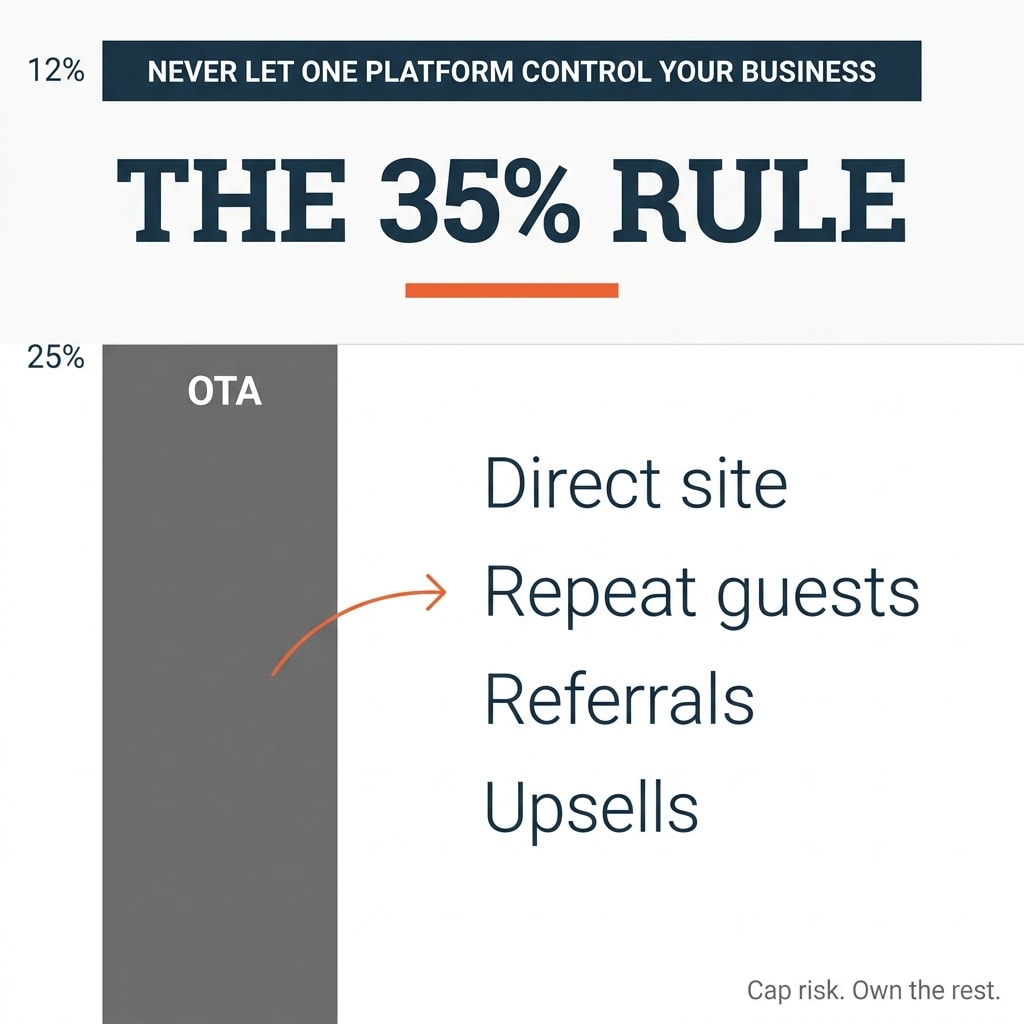
TL;DR: No more than 35% of your total revenue should come from any single OTA. The rest comes from channels you own. OTAs are a customer-acquisition channel you rent, not the business you own. This piece shows you how to measure your OTA exposure and build the other 65%.
The 35% Rule: Why We Cap How Much Revenue Comes From Any Single OTA
Here's the number most operators don't track but should: <strong>no more than 35% of your total revenue should come from any single online travel agen
By J. Massey June 24, 2026 · 12 min read
Disclosure: This post may contain affiliate links. If you purchase through our links, we may earn a commission at no extra cost to you. We only recommend tools and services J. Massey's team actually uses.
Learn more →
Table of Contents
What the 35% Rule Is
The 35% Rule is a risk-management threshold: never let more than 35% of your total revenue depend on a single online travel agency.
The remaining 65% comes from channels you control. Your direct-booking site. Repeat guests who email to rebook. Referrals from past guests. Upsells at check-in. Revenue that doesn't touch OTA commission structures and doesn't vanish if Airbnb changes a policy or Vrbo adjusts an algorithm.
Why 35%? It's the threshold where a platform still delivers meaningful reach without creating single-point-of-failure risk. If Airbnb is 100% of your revenue and your account gets deactivated, you hit zero overnight. If Airbnb is 35% and you lose the account, you're still operating at 65% while you rebuild.
The cap is operational, not arbitrary. A 65/35 split means OTAs handle discovery and fill nights you couldn't sell otherwise, while most revenue flows through relationships and infrastructure you built. That's the difference between running a listing and running a business.
Key point: The 35% cap turns OTAs into one acquisition channel among several, not your only source of bookings.
Why 100% OTA Revenue Is a Single Point of Failure
We see this pattern in diagnostic calls: operators running 100% of bookings through Airbnb who are one policy change from zero.
The risk is operational, not theoretical. Airbnb's 2025 policy updates created material financial uncertainty for hosts. Cancel three or more reservations per year and you face account suspension or deactivation. Cancellation fees now range from $50 to $1,000, deducted from future payouts. The platform tightened communication restrictions: hosts can't share emails, phone numbers, or personal websites with guests. Collecting emails for marketing outside Airbnb's system is banned unless done via approved tools. Violations result in listing suspension or permanent removal. (source, source)
Airbnb uses AI to monitor host-guest messages to enforce anti-circumvention rules. Hosts see delayed payouts on high-ticket bookings, creating cash-flow pressure for operators managing multiple properties. The platform changes terms with little notice. Relying solely on Airbnb means you play by their rules, with no control over guest communications, deposits, or policy shifts. (source)
The FTC Junk Fees Rule took effect May 12, 2025, requiring short-term lodging providers to disclose total price inclusive of all mandatory fees before consumers commit to purchase. The rule prohibits bait-and-switch pricing and other tactics used to hide total prices. (source)
Operators who haven't built direct booking channels are most exposed to this transparency shift. The new rule requires upfront disclosure of cleaning fees, resort fees, and other mandatory charges, making comparison shopping easier and pressuring hosts to compete on total displayed price. The FTC estimates the rule will save consumers up to 53 million hours per year of wasted time searching for total prices, equivalent to more than $11 billion over the next decade. (source)
Algorithm exposure is a structural risk most operators don't track until they're stung. Airbnb and Booking.com change ranking algorithms, search visibility, and fee structures at any time, with zero notice. You're not running a business on Airbnb. You're running a listing. The business is what you build off-platform.
Key point: 100% OTA dependence turns your operation into a listing on someone else's platform, not a business you control.
The Fee Math: What OTA Dependence Costs You
Here's what OTAs charge hosts as of this article's publish date:
Airbnb operates two fee models. Most home hosts pay a 3% host fee under the split-fee model, while guests pay 14.1% to 16.5% on top. Hotels, serviced apartments, and software-connected hosts pay a host-only fee of 14% to 16%. Airbnb's standardized single fee for software-connected hosts is 15.5%. (source, source)
Vrbo charges about 8% total under the pay-per-booking model: roughly 5% commission plus 3% payment processing. An annual subscription alternative is also offered. (source)
Booking.com charges a 15% commission. (source)
OTA commissions across vacation rentals span 3% to 15%+ depending on platform and model. (source)
The FTC Junk Fees Rule now requires total-price mandatory-fee-inclusive disclosure for short-term lodging, including Airbnb occupancy taxes and fees. Build this into your pricing strategy.
Frame OTA fees as acquisition cost. Fair when capped. Expensive when it's your only channel.
On $40,000 annual STR revenue, OTA fees translate to $6,000 to $10,000 per year going to platforms. Not to property improvement. Not to the mortgage. Not to you. Scale that across 20 units at 70% occupancy and operators hand over $75,000 to $100,000 per year in OTA fees. Directional industry research from SendSquared puts a 200-unit operator at $450,000 to $600,000 per year in commissions. That's not overhead. That's a structural leak.
For a deeper comparison of fee structures and platform differences, see our Airbnb vs. Vrbo comparison.
Key point: OTA fees are fair acquisition cost when capped below 35%, but become a structural leak when they're your only booking channel.
Bar chart comparing host-side fees: Airbnb 3% split-fee vs Airbnb 14–16% host-only fee vs Vrbo ~8% pay-per-booking vs Booking.com ~15% commission
OTAs Are a Customer-Acquisition Channel, Not the Business
OTAs earn their cut for one thing: reach. They bring active demand, built-in trust signals, and a checkout process guests already know. In return, they take commission and apply platform policies that affect cancellations, disputes, payment timing, and what you do with guest details.
The billboard effect is operational. OTAs expose your property to new audiences. When guests discover a property on an OTA but later search for it directly, that initial listing drove the awareness that led to a direct booking. (source)
OTAs are how guests find you once. Your job is to own the relationship after that.
Where OTAs stop earning their cut: repeat guests who already know you. The guest who stayed at your property last summer and wants to rebook doesn't need Airbnb's trust infrastructure. They need a way to reach you directly. If they rebook through Airbnb because you didn't give them another path, you paid 15% commission on a guest you already converted.
STR property managers are paying more than $1 billion per year in commission fees to OTAs on repeat guests who already know and trust the operator but rebook through the platform. (source)
You're not running a business on Airbnb. You're running a listing. The business is what you build off-platform. OTAs handle acquisition and demand smoothing, not your only source of bookings. The goal is a system where OTAs acquire guests and direct booking retains them, without breaking operations.
Key point: OTAs are a customer-acquisition channel you rent. The business is what you own off-platform.
The Five Levers That Build Your Other 65%
Here's the build sequence, in order:
1. Capture guest contact information, every guest, every stay
OTAs restrict direct contact during booking. The stay is the window. WiFi splash pages, welcome cards, digital guestbooks. The tool category is Airbnb marketing automation, and the tactic is simple: collect the email before checkout.
A host with 40 annual bookings who captures email from 50% of guests builds a database of 60 past guests in three years. With a 20% annual repeat rate, that yields 12 direct bookings per year at zero commission. After five years: 200 past guests, 30 annual direct bookings. A direct booking channel no algorithm change or OTA fee increase takes away. (source)
For templates and messaging that work, see our guest message templates.
2. Earn the repeat booking (the second booking costs zero commission)
Email follow-up after checkout with a return-guest offer. The guest already trusts you. Your job is to give them a reason and a path to book direct next time.
Repeat guests accounted for 32% of vacation rental bookings in 2023, and a 22% repeat guest rate separates profitable operators from those bleeding OTA commissions. Industry benchmarks put well-managed vacation rental businesses at 15% to 30% of bookings from repeat guests, with the highest rates among operators who invest in direct booking channels and guest relationship management. (source, source)
86% of guests who booked directly returned via the same channel, compared with 89% of guests who first booked via Airbnb. OTA guests stay loyal to the platform unless you convert them. Operators with weak direct booking strategies lose the highest share of repeat revenue to OTAs. (source)
Repeat guests require zero acquisition cost, have higher booking conversion rates, and tend to leave positive reviews. They're among the most profitable segments for vacation rental operators. For context on how repeat bookings affect your overall performance, see our guide on occupancy rate.
3. Build a referral loop (every satisfied guest is a potential source of future bookings at zero acquisition cost)
A simple referral incentive creates a word-of-mouth channel you own. Discount for the referring guest plus discount for the new guest. No platform required.
4. Stand up a direct-booking site (this is the infrastructure that makes everything else work)
Short-term rental booking software options include Lodgify, OwnerRez, Boostly, Hostfully, Guesty, and Hostaway. Your site needs mobile-responsive design, real-time availability sync, secure payment processing, clear cancellation policies, and guest review display.
This is where the channel shift becomes measurable. You track direct booking percentage month over month.
Properties with a strong direct booking channel generate 20% to 30% more revenue per available unit than comparable OTA-dependent properties, because every direct booking is a full-margin booking. (source)
Direct bookings increase net revenue by eliminating third-party commission fees. Operators who balance OTA discovery with direct retention achieve better profit margins. (source)
67% of travelers believe booking accommodations through a brand's own website is more cost-effective than using third-party sites like Airbnb, Booking.com, and Vrbo. Consumer receptivity to direct booking offers is high. (source)
5. Add upsells you own (early check-in, late check-out, local experience packages, curated add-ons)
These revenue streams live entirely off-platform. They don't touch OTA commission calculations. They increase total revenue per booking on channels you control.
Key point: The five levers work in sequence. Contact capture first, always. You can't earn a repeat booking if you don't have the guest's email.
Five-step direct-revenue ladder diagram: capture contact info, repeat bookings, referrals, direct-booking site, upsells — moving from OTA-dependent to owner-controlled
How to Start Capping Your OTA Exposure This Quarter
Step one: measure your current OTA percentage. Most operators don't know this number. Pull your last 90 days of bookings. Calculate what percentage came from each channel. If Airbnb is 80% or 100%, you have a dependency problem.
Step two: set the 35% target as the directional goal. Not a cliff. A direction. You're not cutting OTA inventory cold. You're building direct incrementally, starting with repeat guests and referrals, so overall occupancy doesn't drop while you shift the mix.
Step three: move one lever at a time, in order. Contact capture first, always. You can't earn a repeat booking if you don't have the guest's email. You can't build a referral loop if you're not capturing contact information from satisfied guests. The direct-booking site comes after you have a database to market to.
Timeline: getting from 100% OTA to 65% direct takes 12 to 24 months of consistent execution. No shortcuts. Most operators grow direct bookings without sacrificing overall occupancy if they build direct incrementally rather than cutting OTA inventory cold. (source)
37.5% of short-term rental operators generated more direct bookings in 2025 than in 2024, according to Skift Research data. (source)
Not sure what percentage of your revenue rides on Airbnb right now? On a diagnostic call we map your channel mix and build the plan to get you under the 35% line. Book a diagnostic call here.
Key point: The shift from 100% OTA to 65% direct takes 12 to 24 months. Build incrementally. Track monthly.
Frequently Asked Questions
How much of my STR revenue should come from direct bookings?
Aim for at least 65% from channels you control: direct site, repeat guests, referrals. Keep any single OTA under 35% of total revenue. That cap turns a platform from a dependency into one acquisition channel among several.
What is the 35% Rule for Airbnb hosts?
A risk-management guideline: never let more than 35% of your total revenue depend on a single online travel agency, so one policy change, fee hike, or deactivation can't take down your whole business.
What fees does Airbnb charge hosts?
As of this article's publish date, most home hosts pay a 3% host fee under the split-fee model. Guests pay 14.1% to 16.5% on top. Hotels, serviced apartments, and software-connected hosts pay a host-only fee of 14% to 16%. Source: Airbnb help center.
Is it worth getting off Airbnb completely?
No. OTAs are the strongest customer-acquisition channel in lodging. The goal is to cap dependence, not eliminate it. Keep OTAs for reach while you build direct revenue you own.
How do I get more direct bookings for my short-term rental?
Capture every guest's contact info, ask past guests to rebook direct, add a referral incentive, stand up a direct-booking site with booking software, and offer upsells. Start with contact capture.
Key Takeaways
No more than 35% of your total revenue should come from any single OTA. The rest comes from channels you own.
OTAs are a customer-acquisition channel you rent, not the business you own. The business is what you build off-platform.
OTA fees range from 3% to 15%+. On $40,000 annual revenue, that's $6,000 to $10,000 per year going to platforms.
The five-lever build sequence: capture contact info, earn repeat bookings, build a referral loop, stand up a direct-booking site, add upsells you own.
Contact capture first, always. You can't earn a repeat booking if you don't have the guest's email.
The shift from 100% OTA to 65% direct takes 12 to 24 months. Build incrementally. Track monthly.
67% of travelers believe booking through a brand's own website is more cost-effective than using third-party sites.
This is general education for STR operators, not financial or legal advice. Consult a qualified professional for your situation.
Learn STR Operations the Right Way
Every operator I work with goes through this audit before we build the second channel, the second guest type, the second pricing model. If you want the full framework — the platforms, the compliance sequence, the pricing model that protects margins through regulatory shifts — that's what we map in the STR diagnostic.
Disclaimer: Educational content only — not financial, legal, or tax advice; results vary.
See our full Earnings Disclaimer and Affiliate Disclosure for complete details. © 2026 West Egg Enterprises, Inc. All rights reserved.